CHASSIS KNOWLEDGE
Electric, Range-Extended and Hybrid Commercial Chassis
Understand how energy reaches the wheels, then check how the chassis can support the equipment and working conditions of your special-purpose vehicle.
Separate the drive system from the energy source
Battery electric, range-extended and hybrid describe aspects of the propulsion system. Methanol describes a fuel. A methanol-fuelled engine may be used in different powertrain arrangements. First confirm the exact model and its energy paths.
Three ways to power a commercial vehicle
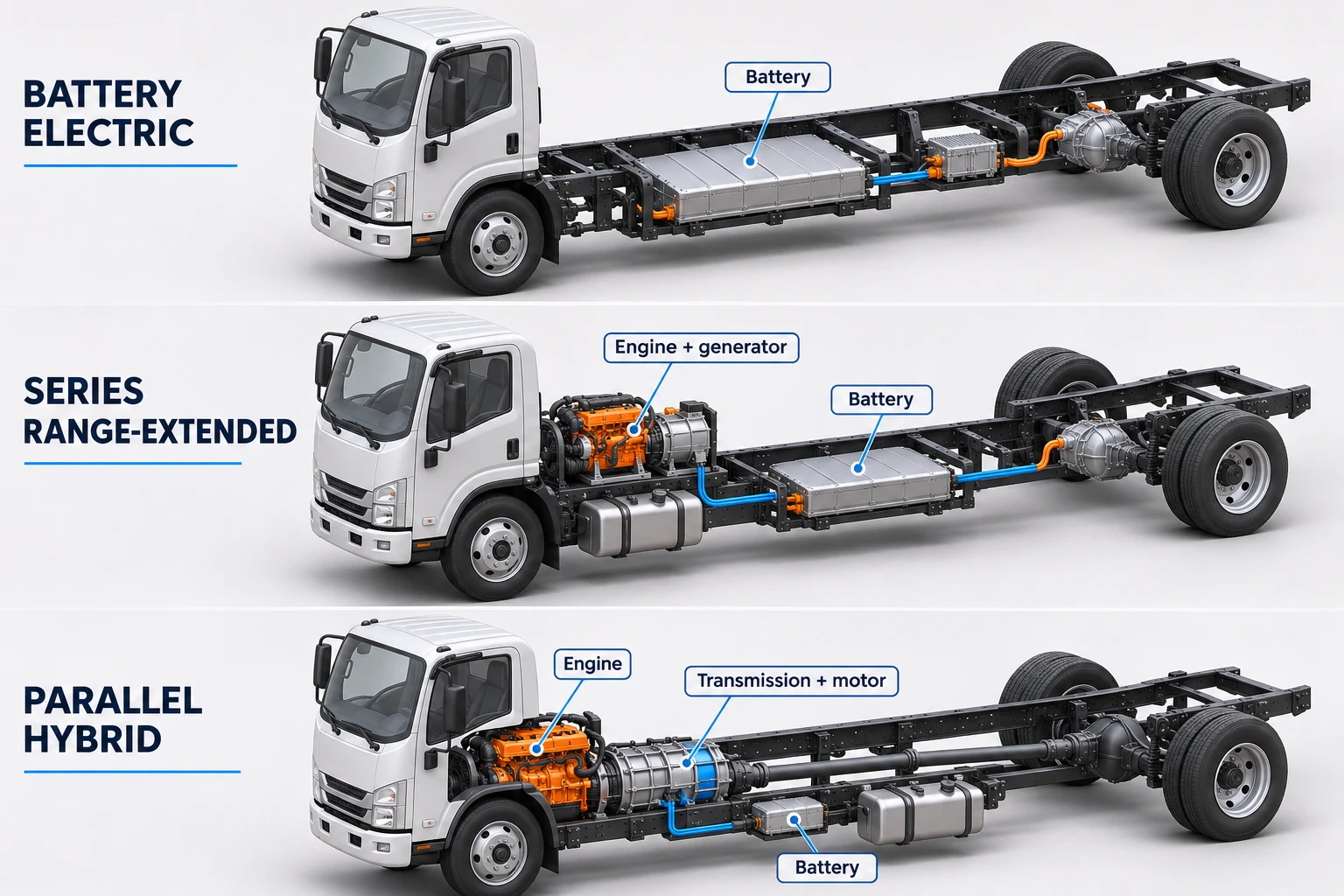
BEV
Battery electric
A battery-electric chassis stores energy in its traction battery and drives through an electric motor. Regenerative braking can recover some energy during deceleration.
For the buyer
Assess the actual route, charging access, operating load and stationary equipment demand together.
SERIES / RANGE-EXTENDED
Range-extended electric
In the series arrangement illustrated here, the engine generates electricity while the traction motor drives the wheels. The battery buffers energy. External charging availability depends on the model.
For the buyer
Check generator output, charge-sustaining performance and fuel supply. A large combined-range claim does not describe continuous stationary power capability.
HEV / PHEV
Hybrid drive
Hybrid designs combine engine and motor power. Parallel and power-split arrangements can transmit engine power mechanically to the wheels. A PHEV can also charge externally. HEV and PHEV describe charging capability, while series, parallel and power-split describe the power paths.
For the buyer
The diagram shows one mechanical path. An electric motor and battery provide an additional path according to the selected architecture. Confirm the actual system rather than inferring it from a badge.
Energy-path explanations show representative architectures. They do not specify the hardware layout of a particular chassis.
FUEL + ARCHITECTURE
Where does methanol-electric fit?
A methanol engine uses methanol fuel. In a methanol-electric series arrangement, that engine drives a generator and the wheels are driven electrically. The fuel label alone does not establish whether there is a mechanical connection from engine to wheels.
Farizon, Geely’s commercial-vehicle brand, presents battery-electric and methanol-electric products as well as range-extender technology. Its “methanol-hydrogen” terminology needs to be read with the specific model documentation. Confirm whether the vehicle uses an internal-combustion engine or a fuel-cell system.
For an overseas project, investigate local methanol availability, fuel specification, refuelling arrangements and service support before selecting the chassis. Fuel sourcing also affects any lifecycle carbon assessment.
Driving energy and working energy must be planned together
Driving the vehicle
Route length, road speed, gradients, ambient temperature, gross mass and auxiliary loads affect energy use. Review the completed conversion and the actual duty cycle when estimating working range.
Operating the body equipment
Air-conditioning, instruments, communications, pumps and workshop equipment have their own continuous and peak demand. A connection to the traction battery depends on OEM-approved interfaces and operating conditions.
Driving demand + stationary working demand + required return reserve
Calculate with the selected equipment and usable energy limits. Battery capacity in kWh and power output in kW answer different questions.Confirm continuous output, peak output, voltage, phase, isolation, permitted stationary operation, low-charge behaviour and interface responsibility. The presence of an engine-generator or a large battery does not establish the available output for body equipment.
Read about body power on an electric chassis → · Power planning for testing vehicles →
Weight and packaging also change the conversion
Batteries, fuel tanks, exhaust equipment and generator systems occupy different chassis locations. Check axle loads, mounting areas, access for service and the manufacturer’s conversion rules. Payload must be assessed for the exact chassis and completed build.
Chinese commercial-vehicle routes — examples to investigate
Official-source review dated 4 November 2026. These examples describe public product and technology information. Procurement availability, export specification and conversion approval must be established for the selected model.
Farizon / Geely commercial vehicles
Its public range includes battery-electric, methanol and methanol-electric products. Its technology pages also describe range-extender development. Identify the specific powertrain rather than applying one route to the whole brand.
Official technology overview ↗Official methanol programme ↗
Foton
Foton presents battery-electric and hybrid commercial products, with model announcements also covering range-extended and plug-in hybrid vehicles. Its light trucks, vans, pickups and heavy trucks need separate model-level checks.
Official new-energy overview ↗BYD commercial vehicles
BYD publishes battery-electric commercial chassis information. Use the relevant chassis specification to establish mass, battery placement, interfaces and conversion suitability.
Official commercial-vehicle website ↗What to send before choosing the powertrain
- Destination country, registration category and any mass restrictions.
- Daily route, road conditions, climate and required return reserve.
- Charging or fuel access at the base and at working sites.
- Working hours while parked and equipment that runs simultaneously.
- Continuous and peak equipment loads, with voltage and phase requirements.
- Payload, occupants, supplies and required interior working space.
- Preferred chassis and the local servicing arrangement.
Prepare a vehicle quotation brief → · Explore vehicle applications →
Common buyer questions
Is every range-extended vehicle externally chargeable?
External charging is a model-level feature. Confirm the charging inlet, supported charging system and usable operating modes.
Can the traction battery power the conversion?
Check the approved output interface, continuous and peak limits, battery protection strategy and the effect on driving reserve with the chassis supplier.
Does methanol-electric mean a hydrogen fuel-cell vehicle?
Check the actual energy-conversion system. Methanol-electric products can use a methanol engine-generator, while a hydrogen fuel-cell system has a different energy-conversion arrangement.
Which route is best for a mobile laboratory or command vehicle?
Compare route energy, stationary equipment demand, payload, local replenishment and service support for the actual project. The same application can lead to different choices in different markets.