Where the Body Gets Its Power When the Engine Is Gone
Electrification takes the engine out — and the PTO with it. What that means for sweeper and water truck bodies, and how to choose between ePTO and independent drive.
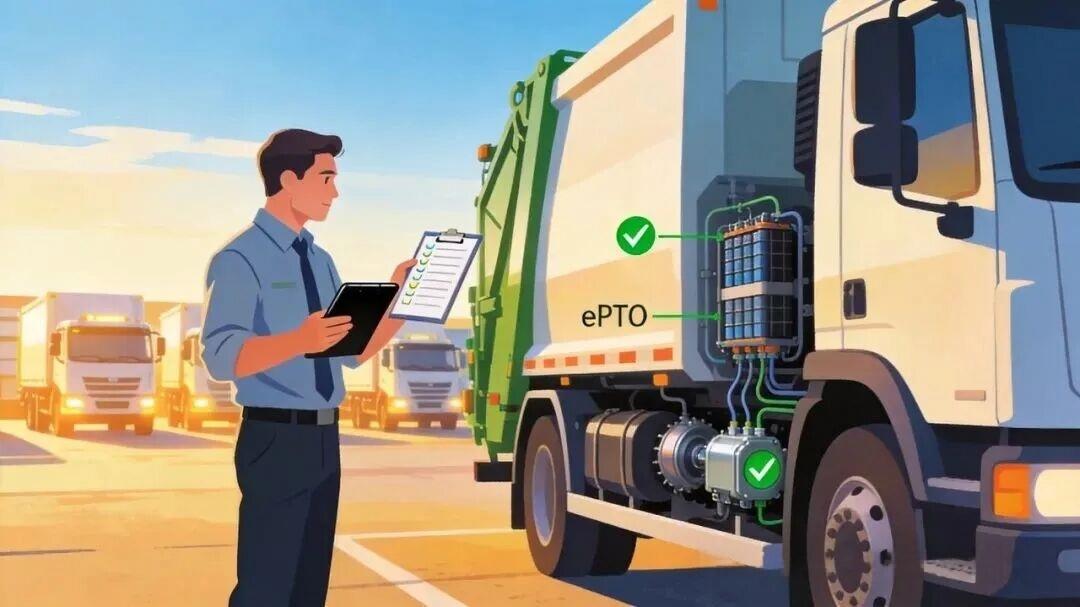
Take the diesel engine out of a municipal chassis and the power take-off goes with it. For as long as these trucks have existed, the body on the back — the blower, the water pump, the brushes — has had exactly one power source, and it was bolted to the engine.
This is the part that gets missed when a fleet specifies an electric sweeper or water truck. The chassis gets specified as a vehicle. The body gets specified as a list of equipment. Nobody writes down where that equipment gets its power.
What follows is how the problem shows up in an actual build, the two ways out of it, and how to choose between them.
What a PTO actually is
On a diesel chassis the body has one power source: the power take-off. It is a gearbox bolted to the transmission, or driven off the flywheel, that takes a share of the engine’s output and hands it to a hydraulic pump, a blower, a water pump.
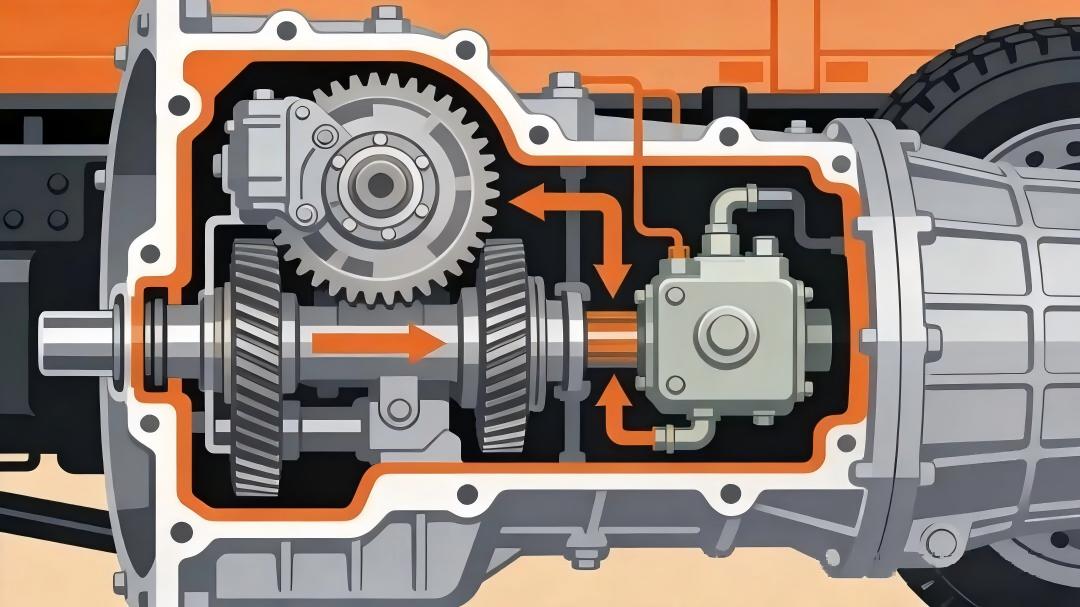
It is simple, it is cheap, and the gear mesh itself is efficient.
The problem was never the gears. It was the job.
The job was never what the PTO was designed for
A sweeper working a street is asking a truck powertrain to do something it was not designed to do. It is crawling — and at the same time running a blower, a water pump and the brushes, for hours.
So the engine has to do two things at once that do not want to be done at once: move the truck at walking pace, and deliver a steady block of power to the body.
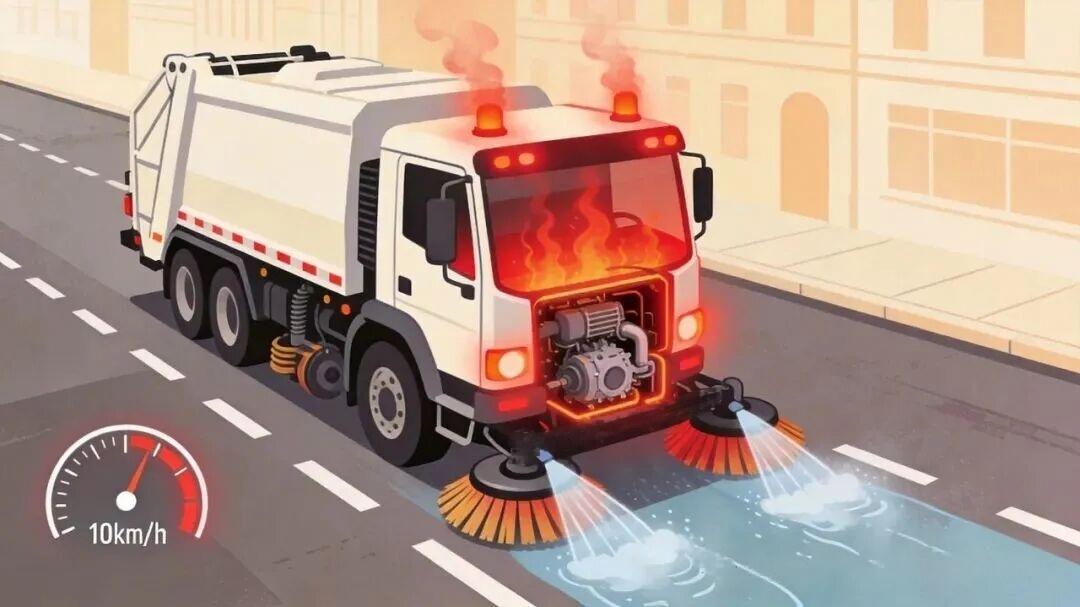
Low speed and high load is exactly where an engine is worst. Everything downstream pays for it. Transmission oil temperature climbs. The radiator gets almost no air because the truck is barely moving. On a diesel with a DPF, exhaust temperature can fall under what regeneration needs, and then the aftertreatment starts complaining.
We are not going to quote you a failure percentage, because we have not seen a source we would stand behind. But anyone who has run a municipal fleet knows which trucks spend the most time in the workshop. It is the ones that work standing still.
The short version: the PTO asked a powertrain designed for highway running to sit still and generate power. It worked, badly, for decades — because diesel was cheap and nobody was counting.
What electrification actually removes
The obvious assumption is that this problem disappears with the engine. Electric motors make torque at zero speed. Just take power off them.
It is not that simple.
The common e-axle has no neutral in the mechanical sense. Motor and reduction gears stay meshed. The “N” on the shifter is an electrical disconnect, not a gear position. So you cannot hold the truck still and spin a shaft for the body — if the motor turns, the wheels turn.
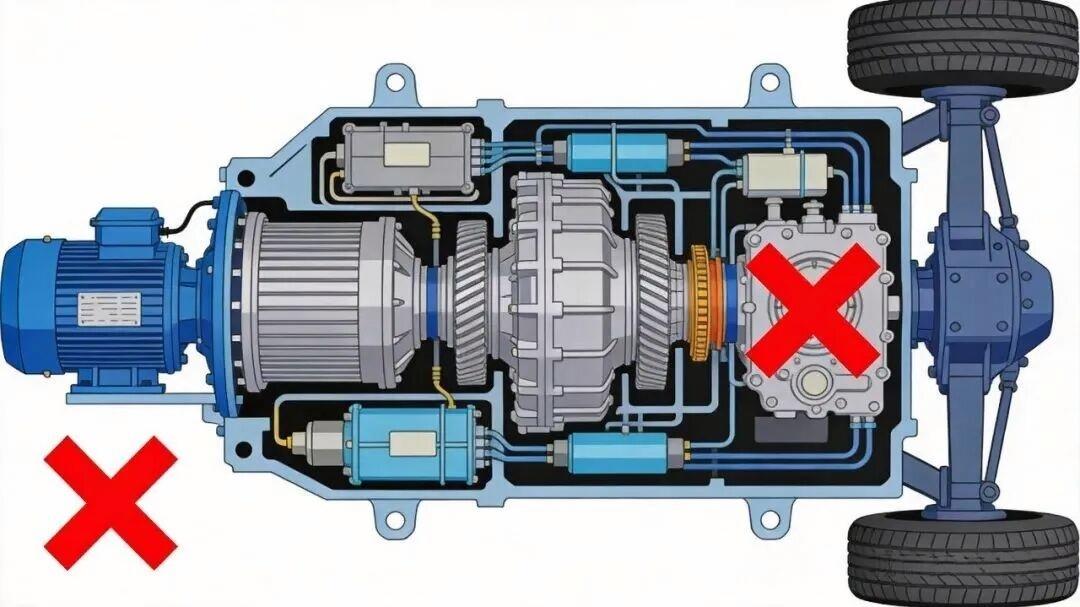
Space is the second problem. On a typical e-axle the motor sits across the axle, and the available width is already spoken for. There is no window left to bolt on a take-off and a pump.
Some newer axles do offer a take-off. But the take-offs fitted to e-axles are sized for short bursts — tipping a body, half a minute or so — not for continuous duty.
And this is the part that matters for a sweeper: it is not a peak power problem, it is a continuous power problem. A tipper needs a lot of power for thirty seconds. A sweeper needs its blower, pump and brushes running for a full shift. What happens thermally over four to six hours is a different question from a thirty-second burst, and it is the one that decides whether the truck finishes the day.
So the honest summary: these chassis were designed to move a truck on electricity. They were not designed to run a body off it. When the body’s continuous demand is more than the chassis will hand over, something has to give — and it is usually the body that gets blamed.
ePTO: stop borrowing, start supplying
ePTO means the body gets its own motor. Instead of taking mechanical power from the driveline, you take electrical power from the battery and run a motor that drives the pump or the fan directly. The motor is the take-off.
This is not an experiment any more, and the proof is that the industry sat down and wrote an interface for it. ACEA published its ePTO Specification Connection V1.0.0 in July 2025 — a common high-voltage connector, signalling and safety rules, built on ISO 23316-2 for the HV interface and UN ECE R100 for high-voltage safety. California’s HVIP programme runs a separate eligibility track for ePTO. Eaton, Parker Chelsea and others supply these as catalogue parts now.
When an industry writes a connector standard, the argument about whether it is mainstream is finished.
What it changes in engineering terms:
- The body stops fighting the driveline. Stationary work no longer means the powertrain is working against itself.
- Speed becomes variable. Flow and pressure follow demand instead of tracking engine rpm. On a sweeper that means backing off on a clean stretch instead of running flat out all shift.
- The failure modes move. No gearbox overheating, no pump run past its duty cycle. When something does fail it is a motor module, not a transmission teardown.
Two ways to do it, and neither is free
Distributed independent drive. Every body function gets its own motor — blower, water pump, brushes — coordinated by the vehicle controller.
Good: fully decoupled from the chassis, each system sized to what it actually needs, one failure does not take the rest down, and nothing caps you at what the axle will give.
Bad: more motors, more high-voltage cabling, more controllers, more weight, and the energy management logic gets genuinely complicated. The cost is real.
Integrated take-off on the e-axle. Newer axles with a take-off window, sometimes paired with a body motor for the heavier functions.
Good: fewer components, lower cost, uses structure that is already there.
Bad: you are still capped by what the axle will hand over, and long continuous duty still carries thermal risk. It suits light bodies. It does not suit a big sweeper on a long shift.
How to choose — three questions, in this order
We are not going to hand you numbers, because the right numbers come from your chassis supplier and your body, not from an article. What we would do is ask these three, in this order, before anyone signs anything:
- What does the body draw continuously. Not peak, not starting surge — what it holds for the whole shift with everything running at once.
- For how long. A duty cycle measured in seconds and one measured in hours are different engineering problems. Ask the chassis supplier for the continuous rating and the time limit on any take-off, in writing.
- What the real mission is. Tonnage, shift length, and how much of the shift is spent working rather than driving. Chassis selection starts here, not with a catalogue.
Then match the route to the answer. Heavy bodies on long continuous duty go to independent drive. Light bodies with modest, intermittent demand can live on an integrated take-off and the money is better spent elsewhere.
Both mistakes are real. Chasing integration because it is cheaper leaves you with a body that cannot finish a shift. Specifying a separate motor for everything because it sounds robust has you paying for capacity you never use. Everything on a vehicle competes for a finite budget — power most of all.
Where this lands on the upfitter
None of the parts in this argument are the upfitter’s. We do not build the axle, the motor, or the battery.
But the two numbers that decide it — how much continuous power the body needs, and for how long — come out of the body, and the body is the upfitter’s. The chassis supplier cannot size an interface for a body nobody has specified yet, and the spec is usually still written the way it was written for diesel.
That is the actual value here, and it is not a product. It is getting the specification right before the chassis is ordered, instead of delivering a truck that cannot finish a shift.
If you are specifying an electric chassis for a sweeper or a water truck, send us the body’s power list and the shift length before the chassis is locked. We will tell you which route we would take and why — including when the cheaper one is the right one.
Planning a build?
Tell us your operational requirements — we'll come back with an engineered proposal.
WeChat QR

WhatsApp QR