BUYER KNOWLEDGE
Rescue body construction: metal frames, sandwich panels and honeycomb
A construction method, a material and a temperature-control function answer different questions. They can coexist in the same body.
Three different ways to describe a body
Construction
Sheet-metal / framed bodies and large-panel assembly describe how the body is made. “All-metal” still needs its frame, skins, floor and insulation defined.
Material system
Steel, aluminium, FRP/GRP composite skins, foam cores and honeycomb cores describe constituent materials or panel structures.
Function
Insulated, refrigerated, workshop, command and equipment-storage bodies describe the job and environment. They are not mutually exclusive material grades.
Read the layers—not just the material name
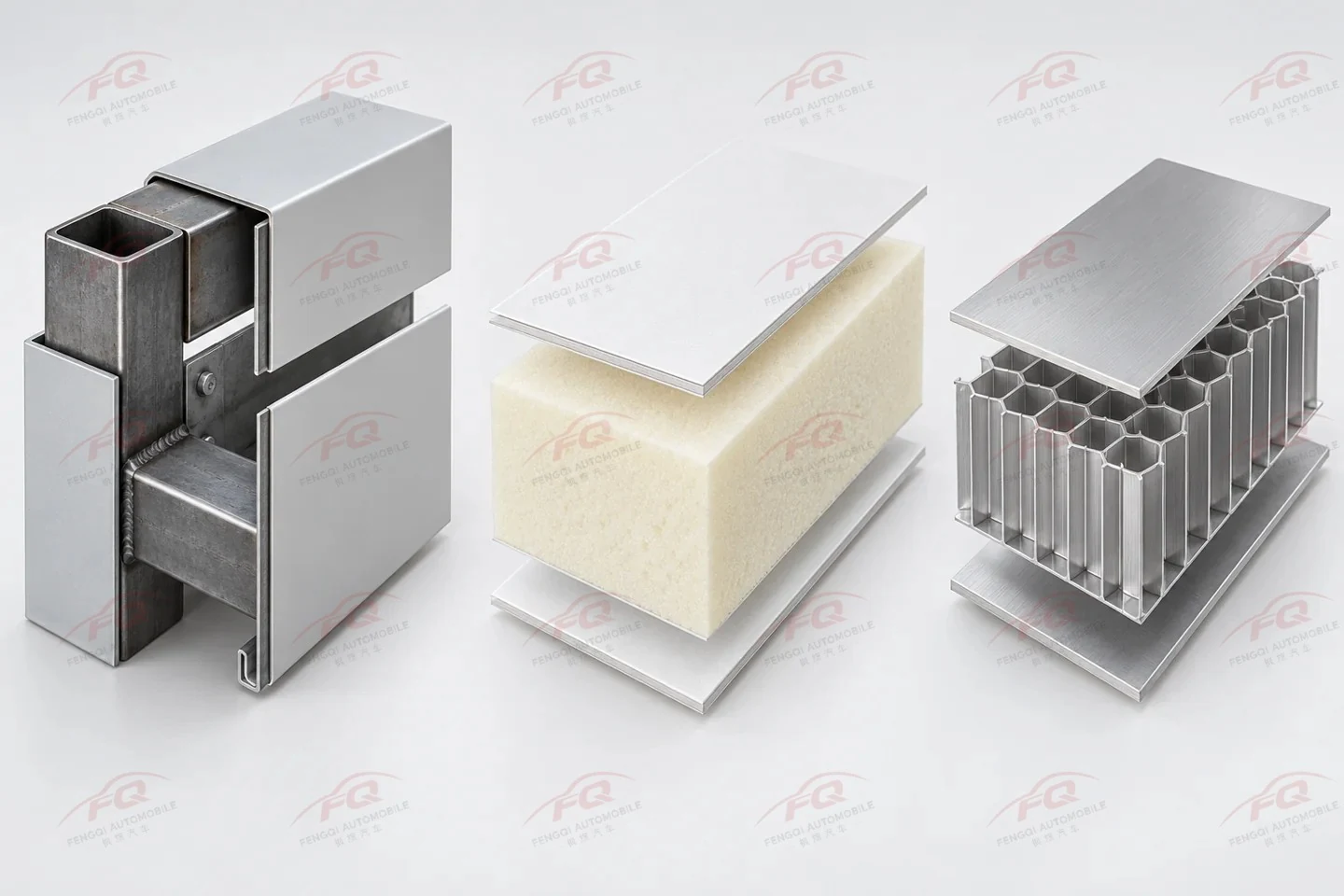
Frame and metal skin
A frame provides defined connection points; sheet skins enclose the body. Weight, corrosion protection, insulation and weld or joint details depend on the actual design.
Foam-core sandwich panel
Face sheets bonded to a core form a panel. Skins may be metal or FRP; insulation depends on core, thickness, joints and thermal bridges. “Large-panel” does not identify the core by itself.
Honeycomb-core panel
Thin face sheets and a cellular core can provide stiffness at low panel mass. Core material, moisture sealing, edge closures and reinforced inserts must be specified; honeycomb is not automatically thermal insulation.
Large-format laminated sandwich panels with integrated framing
A large body panel is more than a face sheet bonded to a foam core. In the construction described here, the panel incorporates its framework, multiple board layers and face panels into one assembly. The layer sequence, reinforcement and materials are defined for the project.
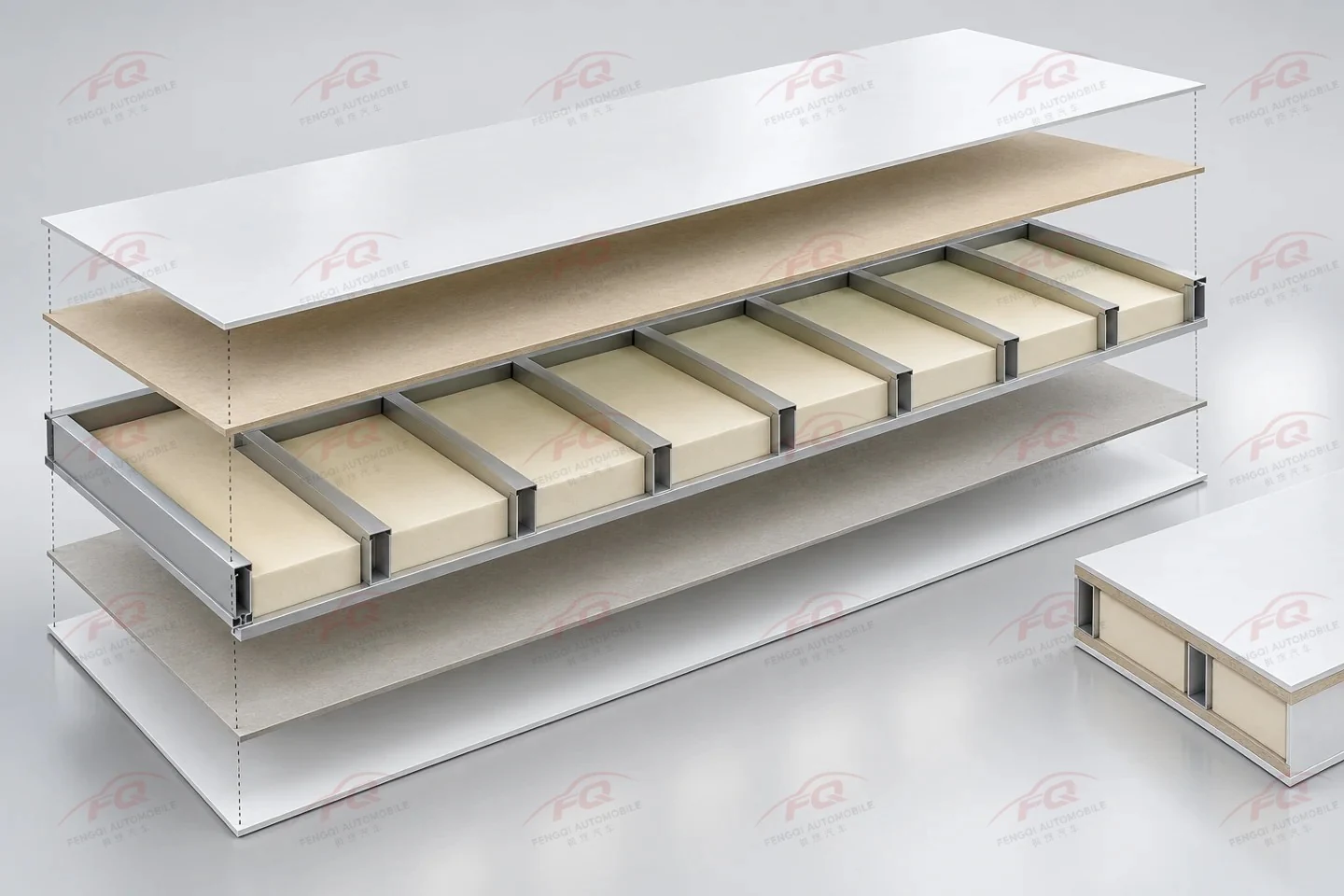
Face sheets
The outer and inner surfaces enclose the assembly. Specify the finish and material for each side.
Board layers
Additional layers sit between the face sheets and the central assembly, according to the structural and functional design.
Integrated frame and infill
The framing and infill occupy the central plane of the panel. They are enclosed inside the bonded assembly, not a frame added around a finished board.
Layer arrangement shown for explanation. Frame material, infill, board type, thickness and bonding system vary by project. The small section at the side shows how the separated layers become one panel after bonding.
Lay up the complete panel
Arrange the framework, specified board layers and face panels on the platform, with the required bonding layers. Plan openings, edges and equipment attachment reinforcement as part of the panel design.
Consolidate on a pressure platform
Use positive-pressure pressing or a negative-pressure vacuum platform, according to the chosen process, to press and bond the layers into an integrated panel. These are alternative manufacturing methods, not quality grades.
Assemble the body
Join the completed wall, roof and floor panels, with the designed corner connections, seals and chassis interface. Large-panel manufacture and final body assembly are separate stages.
Where the trade-offs actually occur
Mass and usable load
Compare the complete body—including floor, reinforcement, doors, furniture and equipment. A lightweight panel does not prove a lightweight finished vehicle.
Equipment attachment
Cabinets, generators, lifting systems and roof equipment need defined load paths. Thin skins or panel cores cannot be assumed to accept arbitrary fixings.
Openings and environment
Doors, hatches and expansion sections change structural and sealing requirements. Review rain, dust, condensation and temperature exposure together.
Repair, cost and quantity
Metal repairs, bonded-panel repairs, tooling and replacement parts need different processes. Compare the same layout and performance scope, then consider local repair capability and order volume.
Insulated is not the same as refrigerated
An insulated enclosure limits heat transfer. Refrigeration additionally needs a defined temperature range, cooling capacity, power supply and controls. Door opening, ambient conditions and the load inside affect the design. A foam sandwich body may be used for refrigeration or for an occupied workspace; its material name alone proves neither performance nor certification.
Specify the working conditions first
Start with equipment size and mounting loads, crew workflow, transport and working states, ambient conditions, required temperature, access, weight limits and maintenance. Agree skin, core, thickness, joints and reinforcement in the project specification.
Illustrated material combinations explain general principles. They do not confirm which combinations Fengqi manufactures for a particular project or establish fire, structural, insulation or hygiene ratings.
Common buyer questions
Does a large-panel body have no internal frame?
Not necessarily. In the construction described here, the framework is integrated within the multilayer panel together with board layers and face panels. “Large-panel” does not mean frameless.
Are large-panel and composite bodies two separate alternatives?
Not necessarily. Large-panel describes a construction approach; composite describes a material system. A large panel can combine framing, different board layers, face sheets and infill in one bonded assembly.
Does a honeycomb panel automatically provide thermal insulation?
No. Honeycomb describes the cellular core. Thermal performance depends on the core material, face sheets, thickness, joints and thermal bridges. Define the required performance for the whole enclosure.
Is a vacuum-pressed panel better than a pressure-pressed panel?
The process name alone does not establish quality. Assess the layer design, bonding system, process control and finished-panel evidence against the project requirements. Both processes need to suit the selected assembly.
Is an insulated body already a refrigerated body?
No. Insulation limits heat transfer. Refrigeration additionally requires a defined temperature range, cooling capacity, power supply and controls, taking account of ambient conditions and door openings.
Can heavy equipment be fixed anywhere on a sandwich panel?
Do not assume so. Equipment loads need suitable reinforcement, inserts or connections to supporting structure. Agree the equipment positions and loads before manufacturing the panels.
Continue planning
References & scope
Illustrated material combinations explain general principles. They do not confirm which combinations Fengqi manufactures for a particular project or establish fire, structural, insulation or hygiene ratings.