AMBULANCE BUYER KNOWLEDGE
Ambulance equipment list: common prehospital devices and emergency kits
A device name is a starting point, not a complete specification. Match the equipment, accessories and vehicle installation to the service, clinical team and destination.
This is an illustrative procurement guide, not a universal mandatory list or a clinical operating protocol. The responsible medical team defines the configuration under local requirements. Equipment is agreed per project; it is not included in every Fengqi ambulance by default.
Six common equipment categories
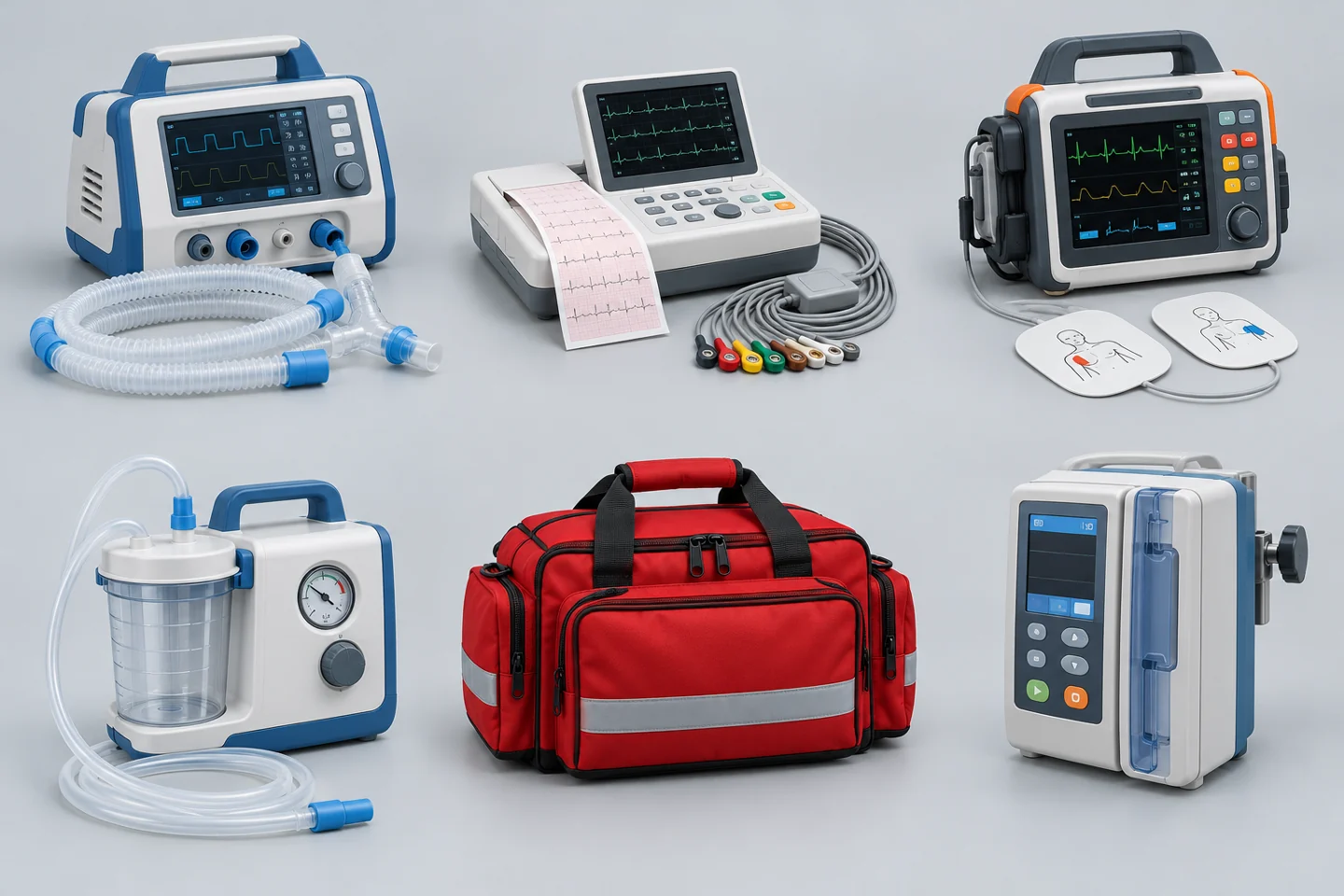
Transport ventilator
What it isA portable device for mechanical respiratory support during patient transport. It is different from a manual bag-valve-mask resuscitator.
Confirm before quotationPatient population, required functions, oxygen supply and connectors, breathing circuits, battery operation and transport mounting.
ECG machine / electrocardiograph
What it isRecords the heart’s electrical activity. A diagnostic ECG machine and continuous ECG monitoring are different functions.
Confirm before quotationWhether a separate 12-lead ECG recorder is required or the agreed monitor provides the required acquisition; leads, electrodes, printing or data export.
Defibrillator / monitor-defibrillator
What it isEquipment for defibrillation; monitor-defibrillators may combine ECG and other monitoring functions. An AED and a manual monitor-defibrillator are not the same specification.
Confirm before quotationDevice type and required monitoring functions, suitable patient accessories, pads, batteries and approved mounting. Avoid duplicating functions unintentionally.
Portable suction unit / medical aspirator
What it isProvides suction for the clinical team’s airway-care tasks, with a collection container and tubing.
Confirm before quotationElectric or manual arrangement, suction performance, canister, filter and tubing system, battery/charging and replacement consumables.
Emergency medical bag / resuscitation kit
What it isAn organised set of instruments and supplies, not merely a bag. A basic first-aid bag and an advanced airway kit can have very different contents.
Confirm before quotationItemised contents, quantities, adult/paediatric sizes, reusable or single-use items, sterile packaging, expiry dates where applicable and replenishment.
Infusion pump
What it isControls delivery of fluids. A volumetric infusion pump uses a compatible administration set; a syringe pump delivers from a syringe. They should be specified separately.
Confirm before quotationPump type, number of channels, compatible sets or syringes, battery, alarms, pole or rail clamp and transport suitability.
A full ambulance plan also considers the stretcher and patient handling, oxygen provision, additional monitoring where required, storage and infection-control supplies. The six categories above are not an exhaustive inventory.
What is inside an ambulance emergency bag?
Specify modules and a bill of contents rather than ordering “one emergency kit”. The following examples illustrate different groups; they do not prescribe a complete kit.
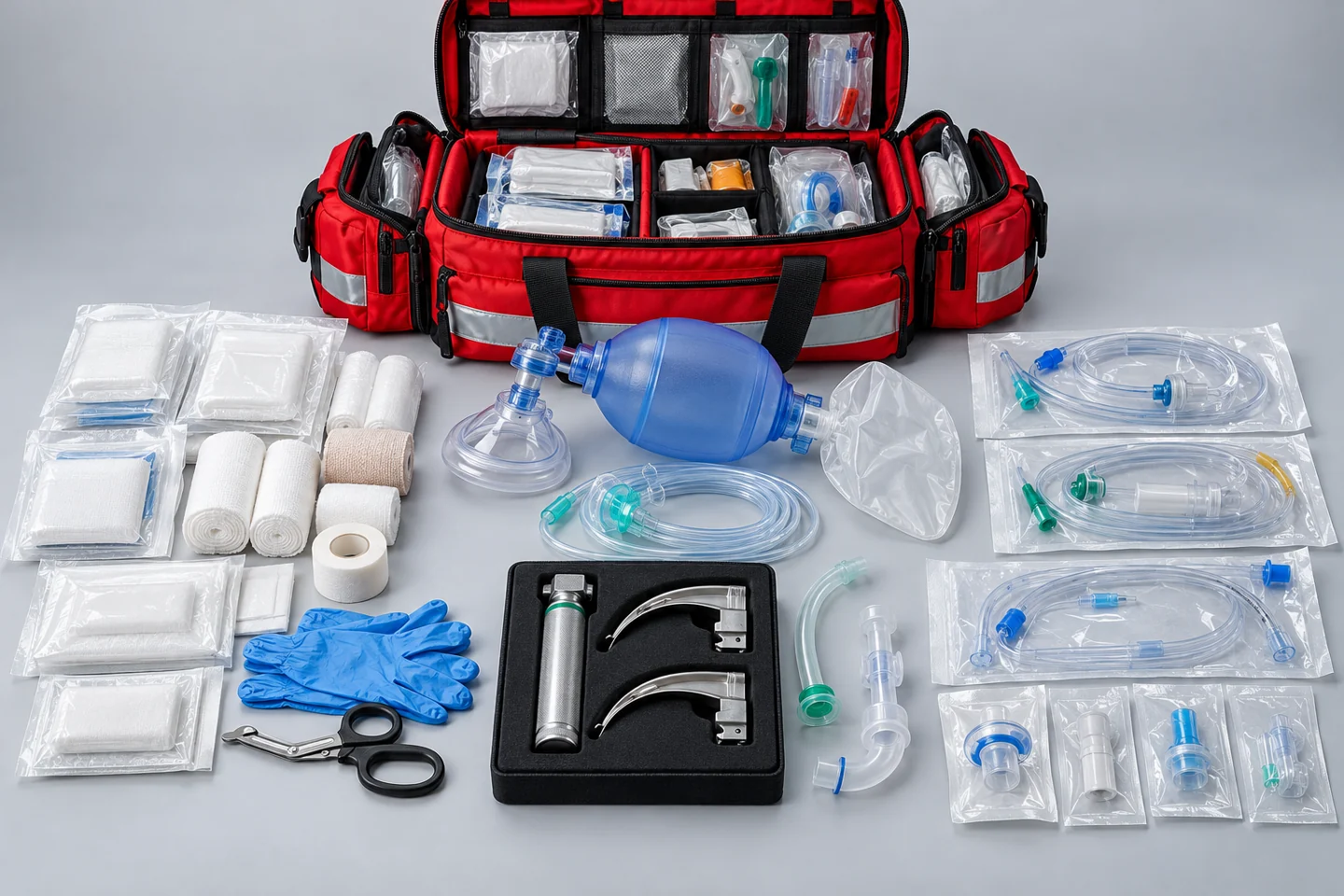
Dressings, protection and basic instruments
Examples: gauze, dressings, bandages, tape, gloves and blunt-tip trauma or bandage shears. Identify pack sizes, quantities and packaging.
Airway and ventilation module
Examples where clinically specified: bag-valve-mask resuscitator, masks, airways, laryngoscope handle and blades, and associated airway accessories. Patient sizes and reusable/disposable choices must be explicit.
Other specified instruments and consumables
Forceps, sealed scalpel/blade packs or other instruments may be included only when specified by the responsible medical team. Confirm the exact item, size, packaging and reprocessing or disposal requirements.
“Blade” is ambiguous: a scalpel blade and a laryngoscope blade are different items. Use the full name, size and intended kit module. Do not assume that either is included in a general first-aid bag.
Medical devices and ambulance conversion are two connected lists
Medical equipment
Agree device model or specification, accessories, quantities, consumables and documents for the destination market.
Vehicle integration
Agree secure mounts, dimensions and mass, charging and power interfaces, oxygen interfaces where applicable, stowage and staff access. A loose device list does not define the completed installation.
Before ordering: can your company import the medical equipment?
Fengqi holds export qualifications and medical-device business qualifications in China. The applicable supplying entity, device scope and supporting documents are confirmed for the project. These qualifications do not replace the buyer’s destination-country import requirements.
Before confirming a vehicle-and-equipment package, identify who will legally import the medical devices and verify whether that entity can handle the named products. A company able to import vehicles may need a different qualification or local partner for medical equipment.
Who will be the medical-device importer?
Name the importing entity and confirm its applicable medical-device import or distribution permissions, or identify the appropriately qualified local partner.
Are the selected devices eligible for the destination?
Check the brand, model, market version and applicable registration or authorisation. Confirm whose registration applies and what manufacturer or local-representative documents are required.
Who will provide local after-sales support?
Confirm warranty coverage for the supply route, installation and training, maintenance, spare parts and consumables with the responsible supplier or authorised service party.
Buy together or separately? Confirm the importer’s role first
Vehicle and equipment package
Before committing, confirm who can act as importer for each device and handle the applicable product authorisations, documentation, customs entry and post-market responsibilities. A package containing regulated devices may require capabilities beyond ordinary vehicle importation.
Separate equipment procurement
The buyer may source medical devices independently, including through an appropriately authorised local supplier, while commissioning the vehicle conversion separately. Agree dimensions, mounts, power, oxygen interfaces where relevant, delivery timing and acceptance responsibilities before the build.
After-sales agreement
Identify the party responsible for warranty, local technical support, commissioning, user training, maintenance and calibration where applicable. Agree spare parts and consumables, response arrangements, repair/return logistics, costs and complaint or recall handling. There is no universal warranty term for every device.
If these points are not yet clear, tell us the destination, intended importer and equipment list before the order is finalised. We can review the supply and integration scope with you: packaged supply where the requirements can be met, separate local equipment procurement, or a mixed arrangement. The buyer should verify local eligibility with the relevant authority or qualified local regulatory adviser.
Does shipping devices inside the ambulance remove their import requirements?
No. Physical shipment with the vehicle does not itself exempt medical devices from applicable destination requirements. The importer and relevant local authority should confirm the route for the named devices before shipment.
Send this information with the equipment list
- Destination and applicable requirements; service and patient population.
- Required function and preferred model, or an acceptable equivalent specification.
- Quantity, accessories, consumables and sizes for each line item.
- Power, oxygen, mounting and storage interfaces.
- Responsibility for supplying, integrating and accepting each item.
Questions buyers often ask
Are all six devices included as standard?
No. Equipment and supply responsibilities are confirmed per project. A photo or a generic list does not establish the delivered package.
Do I need both an ECG machine and a monitor-defibrillator?
It depends on the required diagnostic and monitoring functions of the selected models. Confirm whether the monitor has the required 12-lead acquisition and output; do not assume every defibrillator replaces an ECG recorder.
Is an emergency bag the same as a first-aid kit?
Not necessarily. An EMS bag may contain several specialised modules. Request an itemised contents list, not just the bag name.
Can a hospital device simply be placed in an ambulance?
Check the manufacturer’s intended use, transport suitability, mounting, power and accessory requirements. A device’s presence in the cabin does not establish a suitable installation.
Technical references
References explain terminology and example functions; linked brands are not a promised supply list or endorsement. Fengqi confirms equipment and integration scope per project.
- WHO — Prehospital emergency care: operational guidance for ambulance systems
- Hamilton Medical — transport ventilator features and interfaces
- ZOLL — ECG and monitor-defibrillator functions
- Laerdal — portable suction, collection systems and accessories
- FDA — infusion pumps and syringe pumps
- HERSILL — example itemised airway kit contents
- TGA (Australia) — medical-device import and sponsor responsibilities
- FDA (United States) — device and importer requirements