REAL VEHICLE COMPARISON
Ambulance Interior Materials: OEM, FRP/GRP or ABS?
The same vehicle model. Three interior approaches. Choose around the finished appearance, cabinet layout, development schedule and purchase quantity.
By Fengqi Automobile · Updated · Actual project photographs and published material references
Retained OEM trim keeps the original vehicle finish. Our flat-sheet FRP/GRP lining works with separately built cabinets and customised layouts. Thermoformed ABS enables shaped panels and rounded corners, often with integrated cabinetry. Choose around the purchase quantity, existing moulds, finish and cleaning requirements.
See the difference before comparing the specification
These are Fengqi photographs of the same vehicle model with different interior configurations. Lighting, camera distance, seats and equipment also differ. They are appearance examples, not a controlled material-performance test.
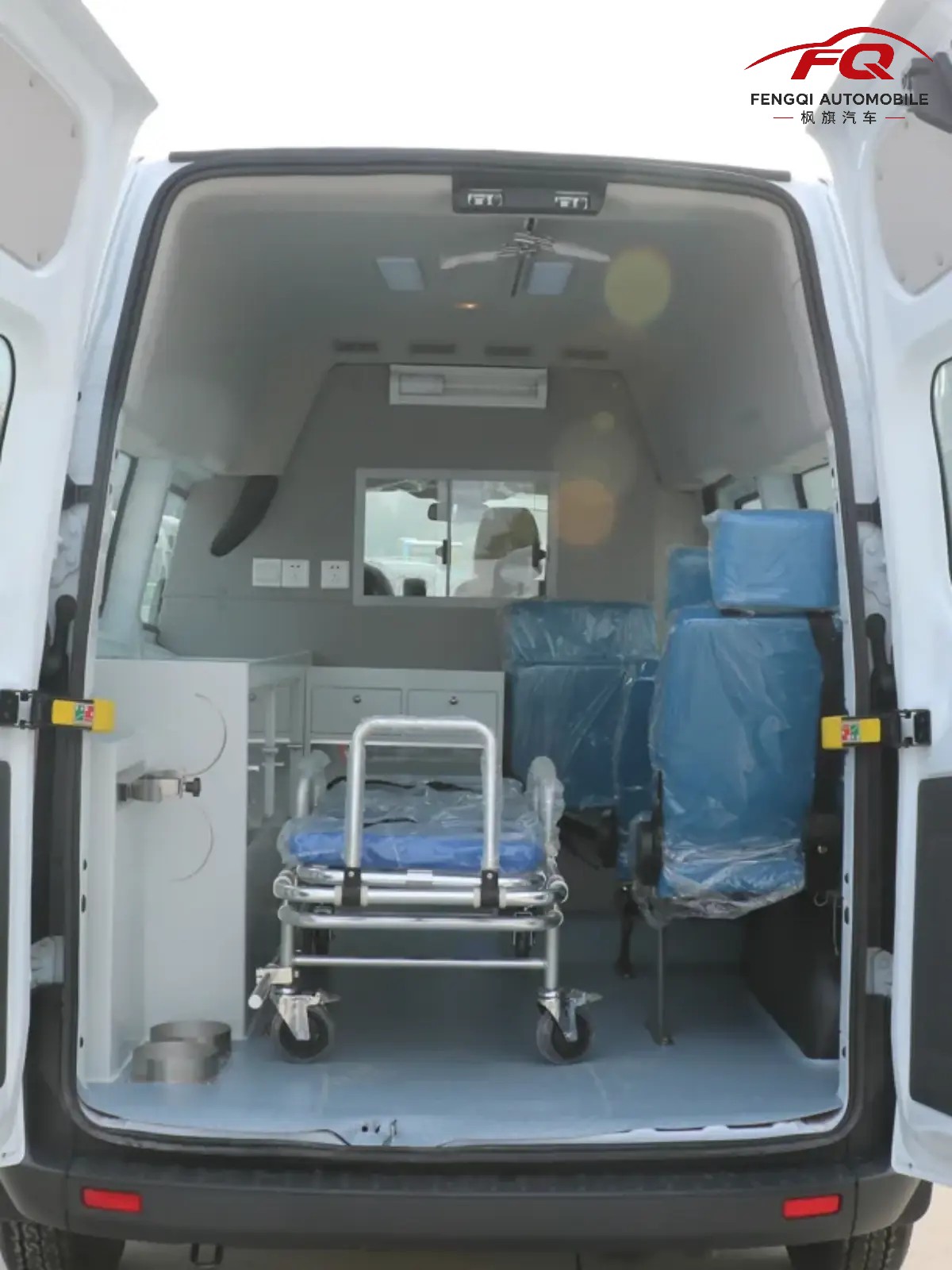
Retained original vehicle trim
Keep the original ceiling and side trim, then integrate the required medical fittings and cabinetry.
The original grey headlining and side trim remain visible. The medical cabinets, seating and equipment are added within that interior.
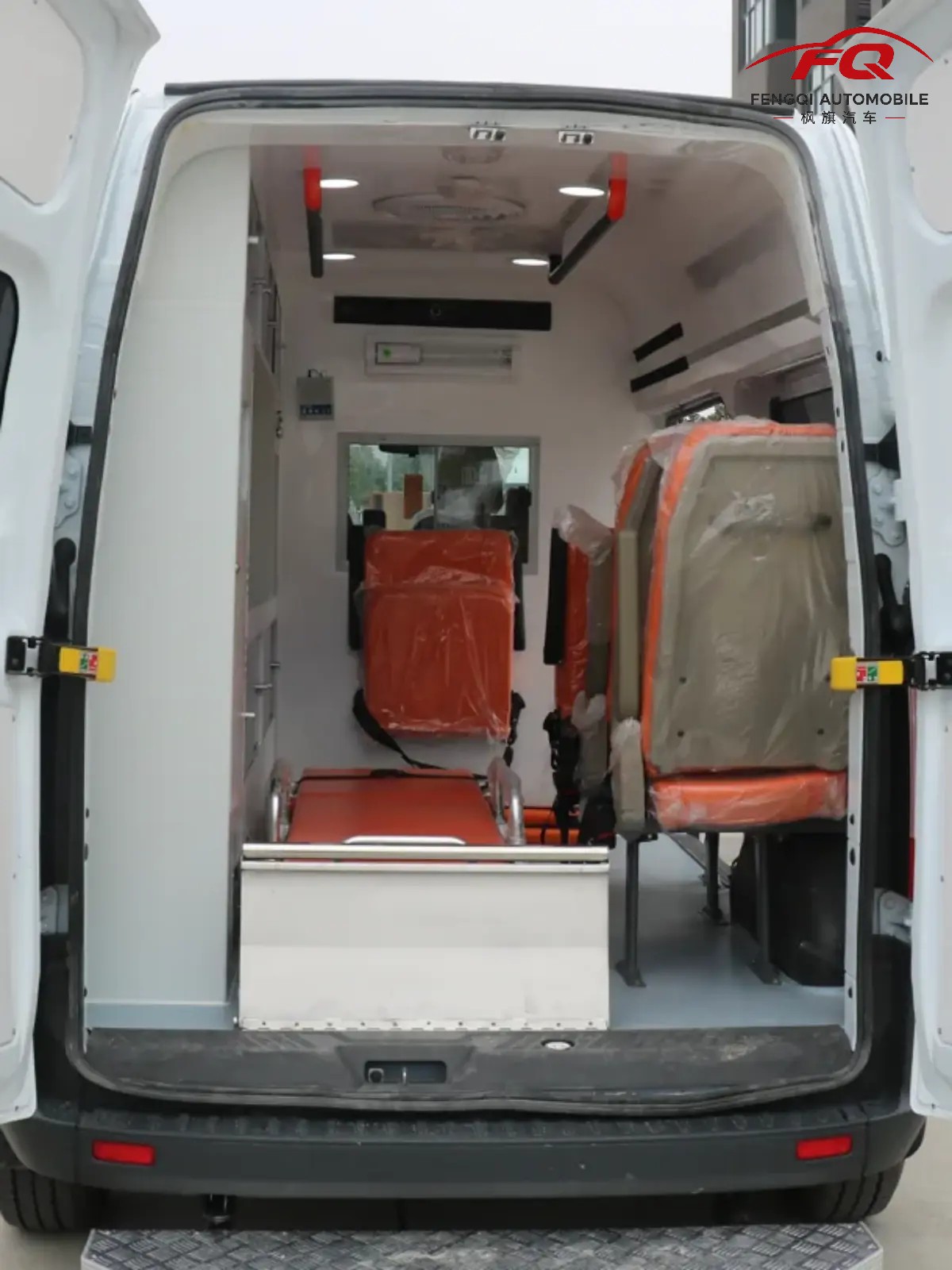
FRP / fiberglass interior
A dedicated medical lining, generally paired with panel-built cabinets in our projects.
The smooth, flat FRP lining may show a faint fibre-and-resin imprint. Its panel joints and separately built cabinets give a different appearance from the shaped ABS interior.
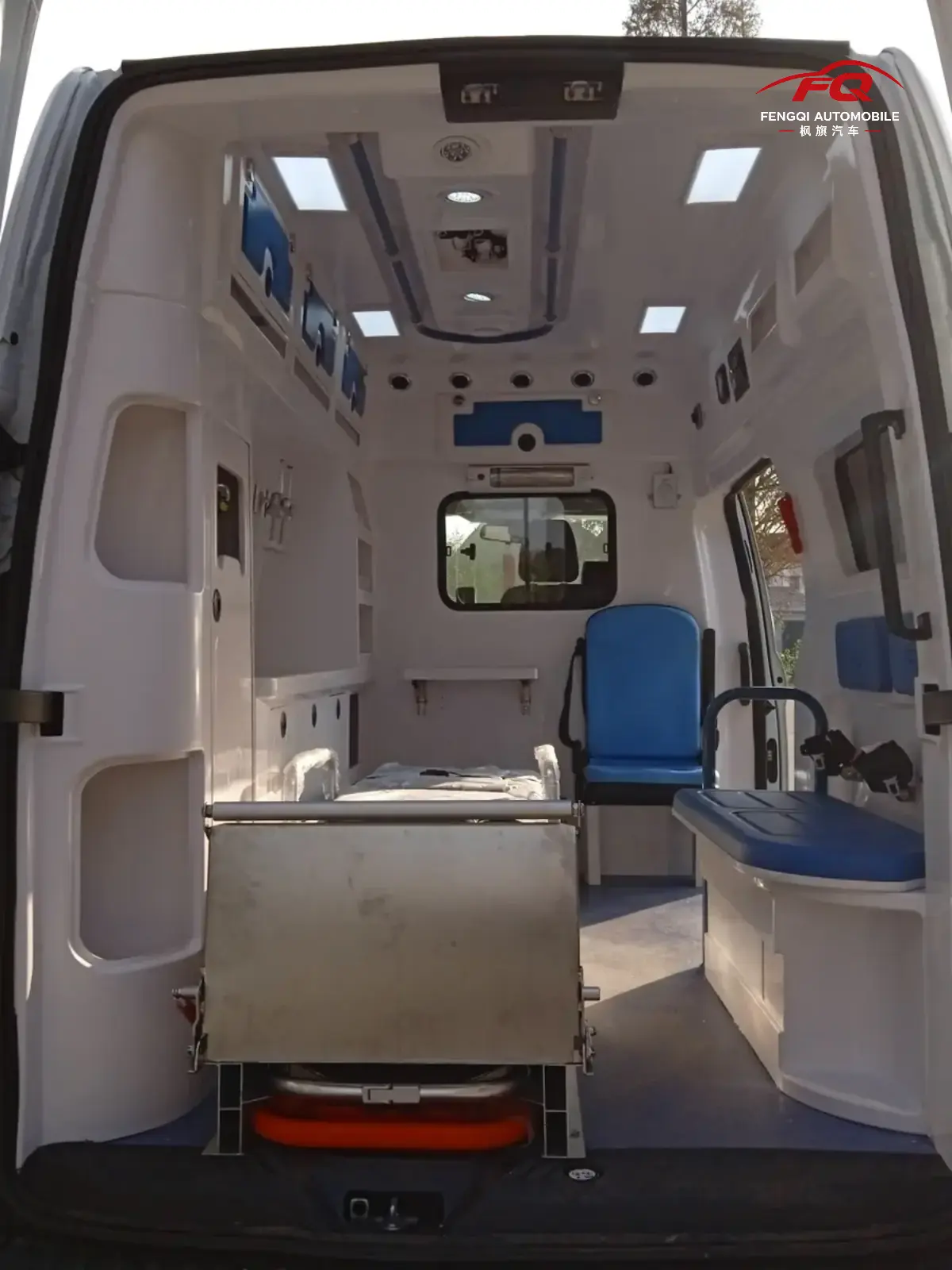
ABS moulded interior
A lining developed around the vehicle’s internal geometry, often combined with integrated ABS cabinetry.
The surface has no glass-fibre print-through. Moulded contours, rounded corners, storage recesses and coordinated lighting openings give a more integrated appearance; the available shapes depend on the mould design.
Click a photograph to open a larger view. Original photographs are preserved; these web copies are resized and compressed.
FRP/GRP vs ABS ambulance interior lining
FRP means fibre-reinforced plastic. GRP (glass-reinforced plastic), fiberglass and fibreglass refer here to the glass-fibre composite lining. ABS means acrylonitrile butadiene styrene; the interior panels discussed here are thermoformed around vehicle-specific moulds. OEM trim means the original vehicle lining retained during the ambulance conversion.
FRP: resin + glass reinforcement
A composite, not solid glass. Resin, fibre content, laminate thickness and the surface finish together affect the finished panel.
ABS: thermoformable plastic sheet
A thermoplastic sheet is heated and shaped on a mould. Grade, starting thickness, draw depth and the remaining thickness after forming matter.
| Property | FRP / fiberglass | ABS sheet | What to compare on the actual interior |
|---|---|---|---|
| Density | Conventional hand-laid glass/polyester example: approximately 1.5 g/cm³. | Royalite R12 example: specific gravity 1.02–1.08, approximately the same numerical range in g/cm³. | ABS is lighter at the same thickness and area in these examples. Total interior weight also includes cabinets, supports, fittings and thickness differences. |
| Stiffness & strength | Depends on resin, glass content, fibre direction, laminate and reinforcement. | R12 example: flexural modulus approximately 1.93 GPa; tensile strength approximately 37.2 MPa. | Check the installed panel’s support and attachment. Raw-material strength is not the load rating of a cabinet or equipment mounting. |
| Heat behaviour | Depends on the resin system and cure. There is no single temperature rating for all FRP interiors. | R12 example: heat-deflection temperature about 104°C on an annealed specimen at 1.82 MPa. | That laboratory test is not a continuous operating-temperature limit or a guarantee for an installed lining. |
| Surface & appearance | In our flat-sheet lining approach, the surface is smooth but may show a shallow fibre-and-resin imprint. Sheets follow the cabin through panel fitting and joints, with limited sculpted detailing. | No glass-fibre imprint. Vehicle-specific moulds can form contours, recesses and rounded corners, often coordinated with integrated cabinetry. | Compare the actual surface and cabinet arrangement in the photos above. This describes our sheet-lined FRP approach; FRP can also be moulded using other processes. |
| Ease of cleaning | A smooth, intact surface can be wiped clean. Panel joints, cabinet edges and sealed transitions need particular attention; a faint fibre imprint does not mean exposed fibres. | Rounded moulded corners can make wiping easier and reduce tight internal corners. Doors, access panels and connections still create joints that need cleaning. | Check accessible corners, sealed seams and cabinet-to-wall connections. Smooth appearance alone does not establish disinfectability. |
| Drug spills & disinfectants | Resistance depends on the resin and exposed finish. An unsuitable chemical can stain or damage that finish; specify compatibility for the actual panel and cabinet surfaces. | Resistance depends on the ABS grade, cleaner and stress in the formed part. Unsuitable agents may cause discolouration or stress cracking; healthcare grades with improved resistance exist. | Provide the actual medicines and cleaners likely to contact surfaces, including concentration and contact time. Check repeated-wipe compatibility—for example with alcohol, chlorine-based or peroxide products—rather than assuming either material tolerates every disinfectant. |
| UV-C disinfection lamps | The glass reinforcement is not the exposed protective surface: the resin, gelcoat or coating needs its own ageing assessment. Do not assume a smooth FRP finish is immune to UV-C. | Tests on ABS samples under mercury-lamp UV-C have shown yellowing, surface microcracking and embrittlement. Results depend on the formulation and exposure; they are not a service-life prediction for every ABS interior. | Specify lamp wavelength, irradiance, distance and operating cycle. Ask for evidence for the supplied surface under the intended cumulative exposure; an outdoor-UV rating is not a UV-C test. |
Reference values illustrate published material examples, not Fengqi vehicle specifications or proof that either material is universally superior. The actual supplied materials must be specified separately.
Ambulance interior cost: cabinets, moulds and quantity
OEM LINING + MEDICAL FIT-OUT
Retained original vehicle trim
This is a fit-out approach, not a third new lining material. Review which original panels are retained and what must change for the medical layout.
Consider when retaining the original interior meets the project’s functional and appearance brief.
CUSTOM MEDICAL LINING
FRP / fiberglass interior
Our FRP interior approach generally has a shorter production time than developing a new ABS mould set. The cabinet layout can be developed separately from the lining.
Consider when the schedule or a smaller, customised order does not justify a new ABS tooling programme.
VEHICLE-SPECIFIC MOULDED LINING
ABS moulded interior
New mould development is a substantial upfront cost. Cabinets may be ABS or panel-built; buyers choosing ABS interiors in our projects generally select an integrated cabinet arrangement.
Often considered for larger procurement programmes where an agreed, repeated specification can support the tooling investment.
Tooling investment
Develop and agree the ABS moulded parts around the vehicle’s internal shape and the intended cabinet arrangement.
Illustration of cost allocation only. It excludes materials, production, assembly, changes and maintenance.
Reusing an existing compatible mould set is different from developing new tooling. A smaller order may still use ABS where suitable tooling already exists. Larger quantities only spread the investment effectively when the vehicle geometry and repeated specification remain compatible.
Choose the approach that fits the procurement programme
Review FRP with panel-built cabinets
In our production approach this usually offers a shorter route than a new ABS mould-development programme. Confirm the actual layout, existing tooling and schedule.
Assess an integrated ABS interior
Review the upfront tooling cost alongside total quantity, repeat orders and the desired consistency of the finished cabin.
Check retained OEM trim
Confirm whether the original lining works with the medical function and the required fittings, access and finish.
Interior material is a design and procurement choice. It does not by itself determine the ambulance’s clinical capability or medical classification.
For a useful comparison, send:
- The vehicle model, body size and steering side.
- The quantity for the first order and any planned repeat purchases.
- Your preferred interior reference photos and cabinet layout.
- The equipment list, required completion date and applicable material requirements.
Ambulance interior material questions
What is the difference between FRP and GRP ambulance interior lining?
FRP means fibre-reinforced plastic; GRP means glass-reinforced plastic, a type of FRP. This guide uses FRP, GRP and fiberglass for the glass-fibre-reinforced lining shown in our photographs. Those names do not specify the resin, thickness or surface finish.
Is ABS better than fiberglass for an ambulance interior?
Neither is the best choice for every order. Our flat-sheet FRP approach suits customised layouts and can avoid a new ABS mould-development programme. Thermoformed ABS supports shaped panels, rounded corners and integrated cabinetry. Compare the required finish, existing tooling, quantity, cleaning regime and schedule.
Why can a new ABS ambulance interior cost more for a small order?
New vehicle-specific moulds require upfront development. Fewer vehicles carry a larger share of that tooling investment. Suitable existing moulds can change the comparison, so there is no universal minimum order quantity or fixed price difference.
Can FRP and ABS interiors be cleaned with disinfectants and UV-C lamps?
Compatibility must be checked for the supplied resin or ABS grade, exposed finish and cleaning cycle. Smooth FRP and rounded ABS can both support cleaning, but neither material name guarantees resistance to every disinfectant or UV-C exposure. Specify the chemical concentration, contact time and lamp conditions before selection.
Next: use the vehicle quotation checklist to prepare your brief, or read the ambulance and medical vehicle HS classification guide for a separate export/import discussion.
Sources & project context
Photographs, material identification and production observations were supplied by Fengqi. FRP with panel-built cabinetry, ABS mould development, cabinet choices and procurement-volume observations describe Fengqi’s experience; they are not universal price or lead-time rules.
- Spartech Royalite R12: ABS sheet technical properties
- Astromal: comparison with conventional hand-laid glass/polyester density
- INEOS Styrolution: healthcare ABS grades and chemical stress-cracking resistance
- Seal Shield: UV-C exposure tests on ABS samples (not a vehicle-lifetime test)
- Polynt: composite processing and surface finishing
Reference material sources reviewed 26 October 2026. No fixed cost difference, minimum economic batch size or manufacturing lead time is claimed without a project-specific quotation.