Buyer guide · Sources reviewed 16 October 2026
Vehicle Shipping Basics: Methods, Space & Spare Parts
Shipping a special-purpose vehicle starts with its actual size, weight, equipment and destination. Choose the transport plan before promising a freight price or packing extra goods inside.
How are vehicles commonly transported?
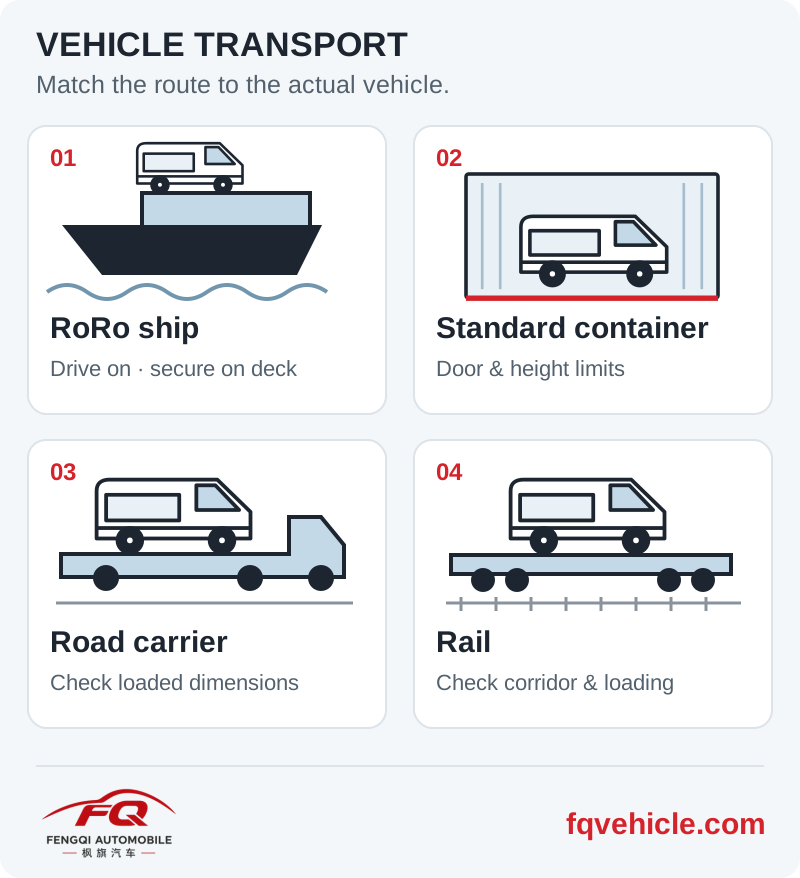
By sea
- Roll-on/roll-off (RoRo): suitable accepted vehicles move through a ship’s ramp and are secured on vehicle decks. Check the sailing route, clearance, operating condition and carrier acceptance for the actual build.
- Standard enclosed container: often practical for passenger cars and smaller vehicles that fit. Many commercial and special-purpose vehicles cannot pass through a standard container door or exceed its internal height. Check the actual door opening, internal space, payload and loading access before choosing this option.
- Open-top, flat rack or breakbulk: alternatives to assess when a standard container will not work. An open-top container can help with some overheight loads, but its width, length, payload and lifting access still impose limits. A flat rack, RoRo service or a suitable breakbulk/general-cargo vessel may be needed instead.
Höegh’s truck shipping guidance explains RoRo acceptance. Maersk’s container securing guide illustrates why vehicle stowage and restraint need planning.
By land
- Vehicle transporter or low-loader: the vehicle travels as cargo. Review the combined loaded height, width, weight, axle loads and route access.
- Rail: an option on suitable corridors, subject to the operator’s equipment, loading limits and acceptance. Road collection and final delivery may still be needed.
- Delivery under its own power: consider only after confirming the applicable registration, permits, insurance and border requirements. Agree the delivery mileage and condition inspection beforehand.
A shipment may combine road, rail and sea legs. Confirm each transfer and the final delivery point, rather than comparing only the main leg. DSV’s rail freight overview describes rail and multimodal services.
Why a commercial vehicle may not fit a standard container
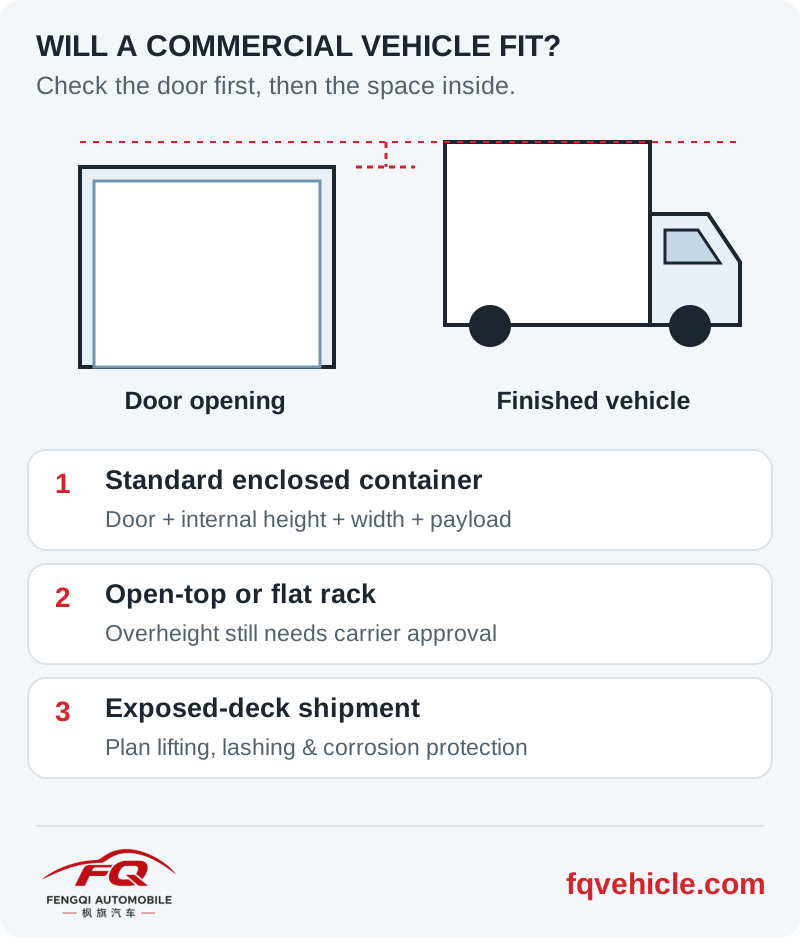
Commercial vehicles differ substantially in body width, overall height, wheelbase and roof equipment. A high-cube container also has finite door and internal clearances. Measure the finished vehicle in its shipping condition, not just the original chassis; include mirrors or other projections that remain in place.
| Container | Door width | Door height | Internal height |
|---|---|---|---|
| 40 ft standard | 2,340 mm | 2,292 mm | 2,395 mm |
| 40 ft high cube | 2,340 mm | 2,597 mm | 2,700 mm |
Do not assume that removing the roof of the container solves every fit problem. Confirm the allocated equipment and an approved loading, lifting and securing plan. Maersk’s equipment guide distinguishes door openings, internal dimensions and special-container limits.
For breakbulk or general-cargo vessels, ask whether the vehicle will be stowed under cover or on an exposed deck. Deck cargo and open transport positions can face salt spray, rain and prolonged moisture. Request a cost breakdown for lifting, slings or spreaders where needed, lashing, dunnage, port handling and protective preparation; these can add to the base freight quotation.
GDV’s truck transport guidance recommends below-deck stowage for sea transport and states that deck carriage must not occur without the shipper’s knowledge. Agree the stowage arrangement explicitly rather than assuming every breakbulk shipment is exposed.
What preparation does an exposed sea shipment need?
Agree a preparation plan for the booked stowage position and voyage. For commercial vehicles, this may include corrosion protection, moisture control and isolation of onboard electrical equipment before handover.
- Clean, dry and protect: clean and dry the vehicle before applying a compatible marine transport wax or other temporary corrosion protection to suitable exposed metal surfaces. Protect sensitive equipment and openings using an agreed covering or packaging system. Keep coatings away from surfaces where they would impair operation, and record how they will be removed after arrival. Check destination cleanliness requirements: wax can trap insects, seeds and dirt, especially in hot weather, as noted in Wallenius Wilhelmsen’s wax-coated cargo guidance.
- Control moisture inside: select desiccant packs as part of a designed moisture-barrier packaging system for sensitive equipment. Their capacity is finite; uncontrolled moisture entry can quickly saturate them. Secure them away from equipment and inspect or remove them on arrival. Simply placing a few bags in an unsealed vehicle does not establish effective corrosion protection, and desiccants cannot replace protection against seawater.
- Prepare auxiliary lead-acid batteries: have the responsible technician isolate auxiliary circuits and, where required by the equipment and carrier instructions, disconnect battery terminals and insulate exposed terminals or cable ends against accidental contact. Label the isolation and reconnection requirements. Confirm the timing with the carrier: RoRo loading may require the starting battery and essential systems to remain operational. Traction batteries need their own specific procedure.
- Record the handover: photograph the vehicle, coating, coverings, securing points, battery isolation and packed accessories. Agree unloading, removal of protection and electrical recommissioning at destination.
GDV’s transport information service explains temporary corrosion protection and desiccant methods. Carrier battery rules vary; Wallenius Wilhelmsen’s used-unit instructions, for example, specify disconnection timing and terminal protection for that cargo category, rather than a universal rule for every new vehicle.
Sea or land transport: what changes for the vehicle?
| Check | Sea transport | Land transport |
|---|---|---|
| Route and handling | Check ports, sailings, transshipment and vessel or container acceptance. | Check border crossings, road or rail access, carrier equipment and transfers. |
| Size and weight | Deck or container clearance, ramps, lifting and securing arrangements matter. | Loaded transport dimensions, axle loads, bridge clearance and route permits matter. |
| Protection | Review moisture, salt exposure where applicable, and securing for vessel movement. Covered decks and containers do not remove every risk. | Review vibration, road spray and weather exposure according to the carrier and route. |
| Preparation | Follow the booked carrier’s fuel, battery, leak prevention and cargo acceptance instructions. | Agree loading, restraint and vehicle condition; delivery under its own power also requires legal road use. |
| Quote comparison | Check lifting, lashing, protective preparation, port handling, storage, destination charges and inland delivery as well as ocean freight. | Check collection, permits, border handling, transfers and final delivery as well as the line-haul price. |
There is no universal “sea is cheaper” or “land is faster” answer. Compare the same origin, destination, scope and delivery conditions. Confirm cargo insurance separately and record the handover condition with photos.
Why are vehicles often described as bulky or low-density freight?
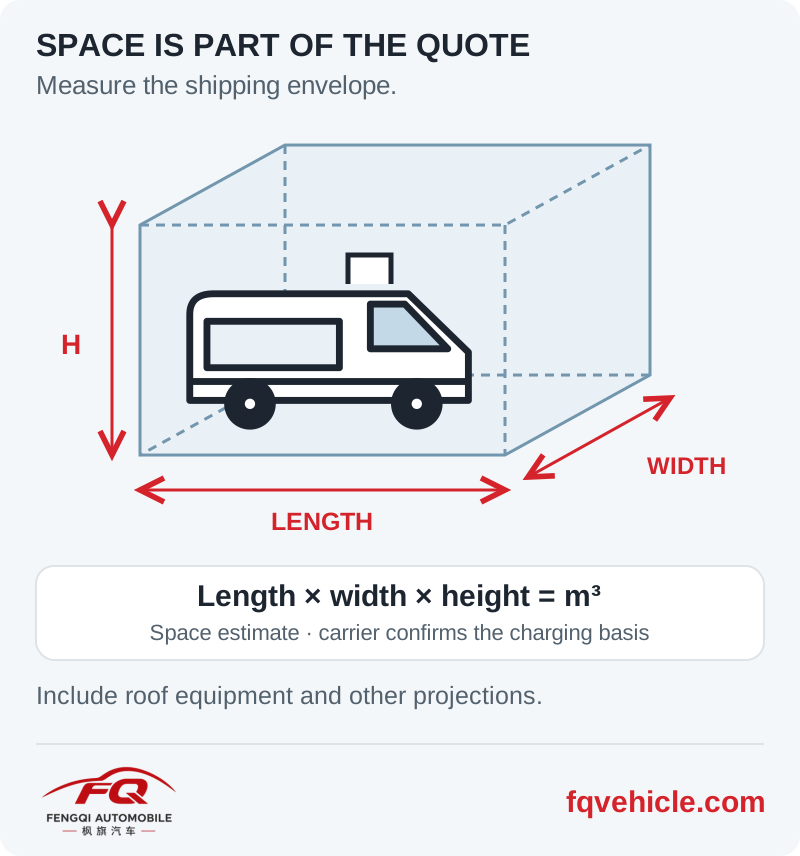
A vehicle occupies a large envelope of space, including the cabin and working compartment, and usually cannot simply be stacked like cartons. The transport space it needs can therefore be significant compared with its weight. This is why traders sometimes call it “light” or “bulky” cargo.
This is not a universal classification for all vehicles. A heavily equipped truck can be weight-limited. The applicable freight basis comes from the carrier’s quotation, not the description “light cargo”.
For an initial space estimate, exterior length × width × height in metres gives cubic metres (m³). Use the shipping configuration, including projections such as roof equipment. Ask whether the carrier uses this envelope or another measurement method.
Vehicle freight may be quoted per unit, by volume, or by weight/measurement. A container booking has a different pricing structure. There is no single weight-to-volume conversion that applies to every vehicle shipment. Ask for the measurement, charging basis and surcharges in writing. Wallenius Wilhelmsen’s vehicle shipping FAQ describes cubic-measurement, weight and per-unit pricing.
Empty space inside a vehicle does not automatically create free cargo capacity. Additional goods can affect acceptance, weight, declarations, handling and insurance.
Can spare parts or other goods travel inside the vehicle?
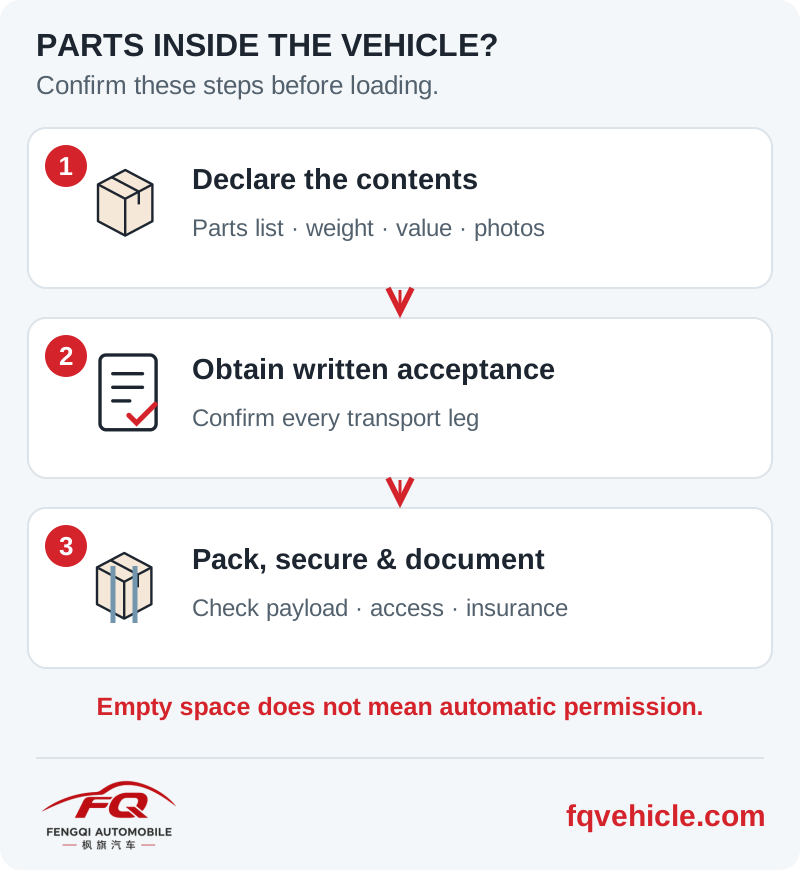
Sometimes, with prior approval. Do not assume permission from the available space. Distinguish permanently installed mission equipment from separately packed spare parts or other goods, and disclose both when booking.
RoRo restrictions can be strict. For example, Höegh’s truck instructions require loose parts and additional batteries to be removed, while its trailer guidance allows certain internal cargo when individually secured and accessible. These are different acceptance cases, not blanket permission to load goods into any truck. Check the carrier’s truck and trailer requirements.
For a container or land shipment, ask the operator to approve the actual vehicle and cargo combination. Approval for one transport leg does not establish approval for the next.
Before putting parts inside, confirm:
- Written acceptance: give the carrier a list, photos, packing details and the intended stowage location. Confirm inspection access and whether separate shipment is required.
- Documentation: identify the parts, quantities, weight and value. Have the forwarder and importer confirm the invoice, packing list and customs declaration treatment. Placing goods inside a vehicle does not exempt them from declaration.
- Safe restraint: agree suitable packaging and securing, check vehicle payload and axle limits, and protect the interior and installed equipment. Do not obstruct operating controls or inspection access.
- Restricted goods: declare spare batteries, gas cylinders, aerosols, oils and other potentially regulated items separately for review. They may require special handling or be refused.
- Insurance and handover: confirm coverage for the vehicle and listed goods; keep an inventory and loading photos.
If acceptance is uncertain, request a separate parts-shipment quotation before loading.
What information helps obtain a useful freight quote?
- Collection location, destination country and exact port, border point or delivery address.
- Vehicle quantity, shipping length/width/height and actual shipping weight, including installed equipment and any approved extra goods.
- Exterior and interior photos; details of projections, lifting or securing points and ground clearance.
- Whether the vehicle runs, steers and brakes; propulsion type, batteries, fuel systems and other equipment needing acceptance review.
- A separate list of spare parts or other goods proposed for carriage inside.
- Required handover date and quotation scope, including loading, unloading, clearance, insurance and final delivery.
Review the plan again if the configuration or shipping dimensions change. Carrier rules and route availability must be checked for the actual booking.