Buyer guide · Sources reviewed 15 October 2026
HS Code 8705 Explained: Special Vehicle Classification & Import Basics
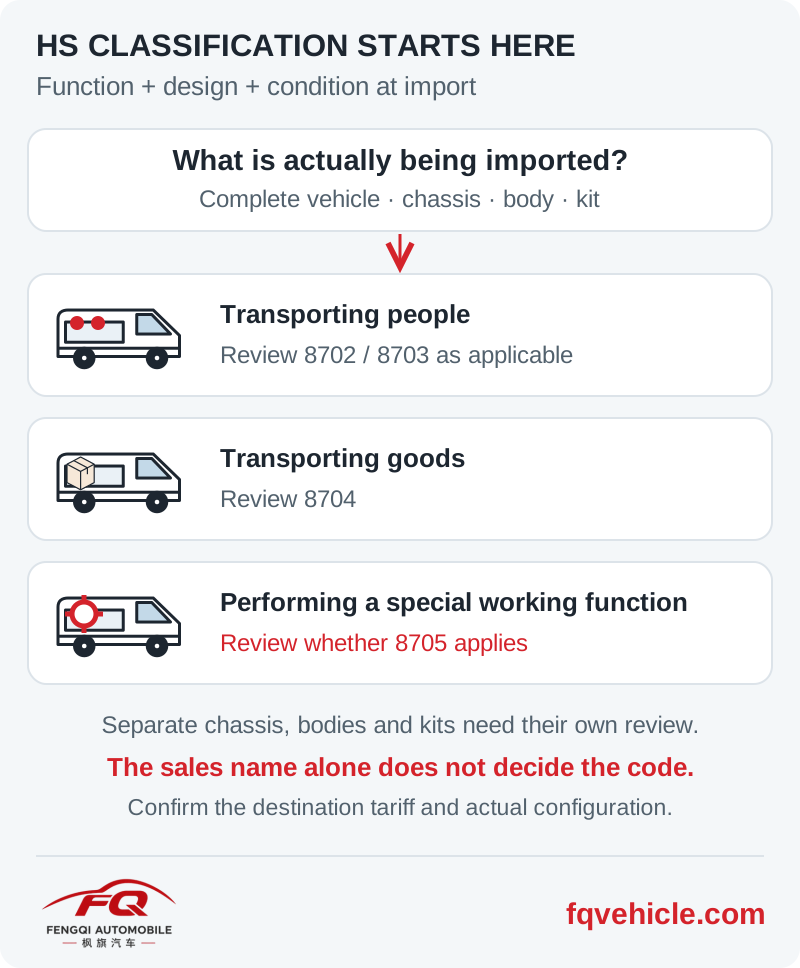
A vehicle marketed as “special-purpose” does not automatically belong to HS heading 8705. Classification starts with its objective design, principal function and condition at import—not its sales name.
What is HS code 8705?
Heading 8705 covers special-purpose motor vehicles other than those principally designed to transport people or goods. Examples in the heading include breakdown trucks, crane trucks, fire-fighting vehicles, concrete mixers, road sweepers, mobile workshops and mobile radiological units.
8705 is a four-digit heading. The international HS subheadings below it have six digits; destination countries add further digits and measures. A four-digit heading alone is not a complete import declaration code or a duty quotation.
| HS subheading | Description |
|---|---|
| 8705.10 | Crane lorries |
| 8705.20 | Mobile drilling derricks |
| 8705.30 | Fire-fighting vehicles |
| 8705.40 | Concrete-mixer lorries |
| 8705.90 | Other vehicles within heading 8705—not a catch-all for every custom vehicle |
8703, 8704 or 8705: start with the function
Heading 8703 concerns vehicles principally designed to transport persons (other than heading 8702); 8704 concerns goods transport. A custom body or installed equipment does not by itself establish 8705.
| Vehicle or use | What the buyer should understand | Explore the build |
|---|---|---|
| Ambulance / patient transport | WCO’s medical classification reference lists ambulances under 8703. Do not assume that medical equipment makes an ambulance 8705. | Ambulance builds |
| Mobile clinic / radiological unit | The same WCO reference lists equipped mobile surgical clinics and mobile radiological units under 8705.90. Actual configuration still matters. | Medical vehicle range |
| Mobile tire workshop | Mobile workshops are included in the heading description. Establish the actual workshop function, equipment installation and remaining transport role. | Tire service and workshop vehicles |
| Command / mobile office vehicle | The name alone does not decide classification. Provide the seating, layout, installed systems and operating function for review. | Command vehicle configurations |
| Shelter or body | A separate shelter or body must be examined in its own delivered condition; the finished vehicle’s code cannot simply be copied. | Shelter and container builds |
These are explanatory examples, not customs rulings for every Fengqi model.
Complete vehicle, chassis, body or unassembled kit?
A complete vehicle, an engine-fitted chassis and a separately supplied body are different goods. Headings 8706 and 8707 may be relevant to qualifying chassis and bodies; not every container or shelter is a vehicle body. Chapter 87 also distinguishes chassis fitted with cabs, which are not classified under 8706.
SKD and CKD are delivery descriptions, not automatic tariff classifications. Under General Interpretative Rule 2(a), an unfinished or unassembled article can sometimes be classified as the complete article. Review exactly what is presented to customs, together with the applicable rules, before agreeing a code.
Why import taxes differ between countries
The international heading is a starting point. The local tariff line, origin, customs value, import date, applicable preferences and exemptions determine the treatment. Customs duty is only one component: import VAT/GST, excise or levies may also apply. Customs clearance and road-registration approval are separate checks.
The examples below explain what to verify. They deliberately do not assign one rate to all 8705 vehicles.
| Market | What to verify before ordering | Official starting point |
|---|---|---|
| Australia | Check the Australian tariff item, general versus eligible preferential treatment, and any applicable concession. Confirm import GST separately; Chinese shipment alone does not prove preferential origin. | ABF Chapter 87 tariff |
| Kenya | Confirm the applicable tariff classification, customs valuation and the treatment of VAT, excise, import declaration fees and railway development levy. Do not copy a passenger-car tax example onto a workshop vehicle. | KRA customs guidance |
| Uzbekistan | The integrated tariff requests the HS code, sending country, origin and value. Use the actual local code and transaction details to check duties and other measures. | Uzbekistan integrated tariff |
Ask for a written landed-cost breakdown
Ask your importer or customs broker to identify the local code, customs value, each tax rate and tax base, any preference or exemption, and charges excluded from the estimate. Record its date and assumptions. A percentage without this context is not a reliable comparison.
What information should you prepare?
- Destination country, port and intended use.
- Complete vehicle, chassis, body or kit delivery, including the exact shipment contents.
- Chassis specification, propulsion, dimensions, gross vehicle weight and seating.
- Internal layout, exterior and interior photos, and a fixed-equipment list describing how the vehicle works.
- Origin documentation and commercial transaction details for valuation and any preference review.
Fengqi can prepare the vehicle description, configuration and available technical documents for your importer or broker to review. Final classification and taxes are determined under the applicable destination rules and customs decisions.
Common questions
Does HS 8705 mean duty-free?
No. The heading does not establish one worldwide duty rate or exemption. Check the complete destination tariff line and conditions.
Can I use the supplier’s export code for import?
Use it as supporting information, not an automatic final answer. The importing country’s additional digits, measures and interpretation need to be checked.
Can I choose a lower-tax code?
Classification must match the goods and applicable rules. Changing the description or invoice to obtain a preferred rate is not a substitute for correct classification.
What if the classification is uncertain?
Have the importer consult a qualified local broker or customs authority before shipment. Where available, request an advance classification ruling using the actual technical configuration.
Official sources and scope
- Australian Border Force — Chapter 87, including headings and subheadings
- WCO — medical goods classification reference (HS 2022; ambulances and mobile clinics)
- ABF — General Rules for Interpretation
Sources reviewed on 15 October 2026. This is introductory guidance, not a binding classification or a destination-specific tax quote. Recheck the rules and rates for the actual shipment.