Official sources reviewed 16 October 2026
Buying a Special Vehicle: Approval by Destination
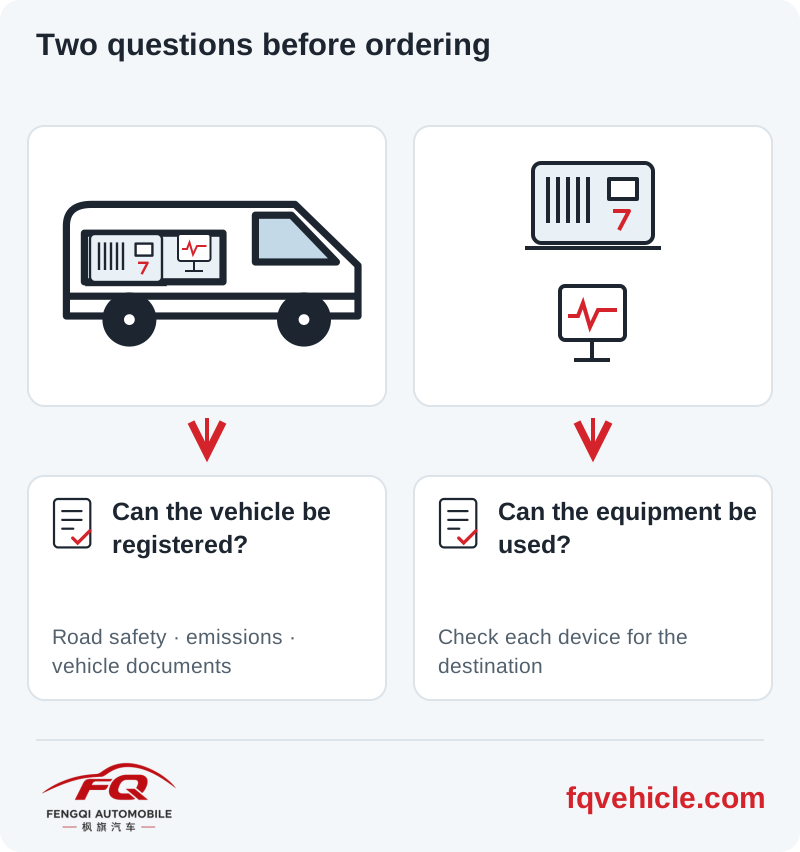
Start with the country where the vehicle will work. Then check whether the vehicle can be registered, whether its equipment can be used, and who handles the paperwork.
Asia
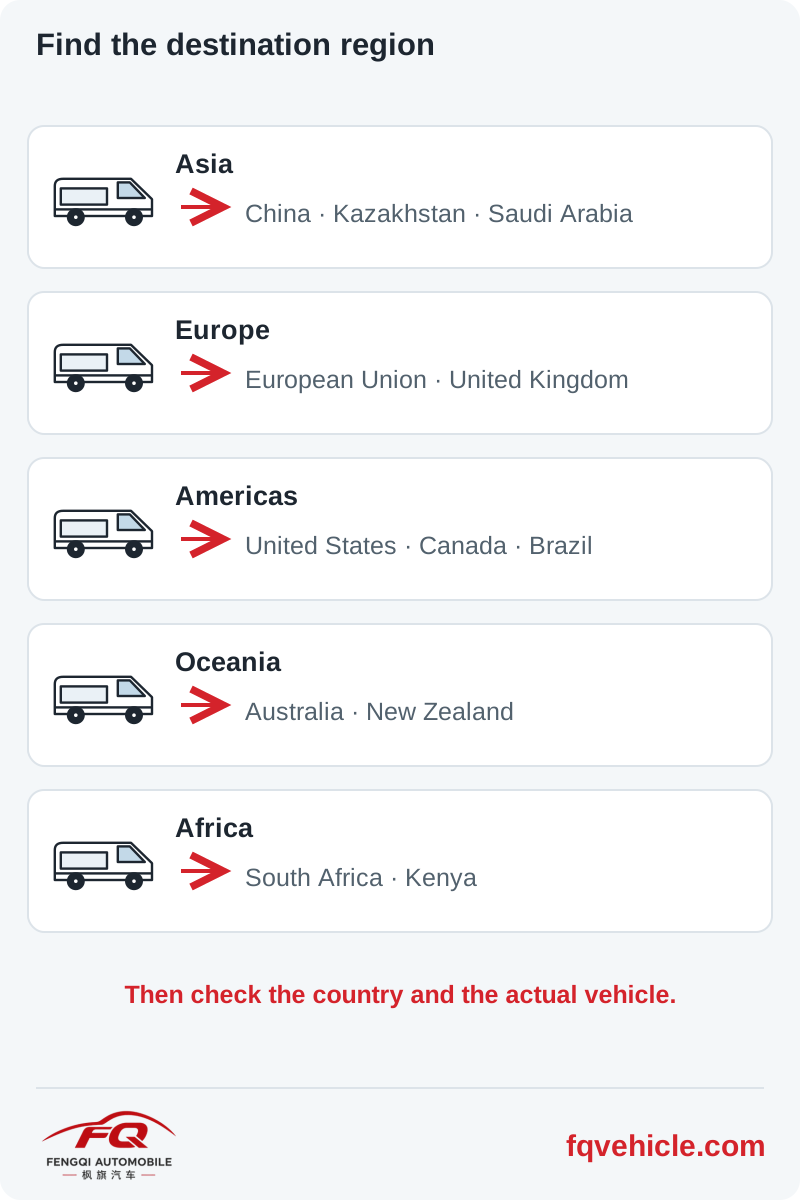
Find your region below, then check the country. These are selected examples, not a complete list of national requirements.
China
For vehicles used in China, CCC concerns product certification; the MIIT model announcement concerns vehicle admission. Environmental information, the vehicle consistency certificate and the factory-issued vehicle certificate have different purposes.
Confirm the model and its documents. For export-only orders, check the applicable export conditions rather than copying the domestic registration checklist.
Kazakhstan
OTTS (ОТТС, also written OTTC) is a vehicle model approval document used under the relevant rules. Kazakhstan’s official service refers to TR CU 018/2011.
Ask the importer which approval documents this vehicle needs for import and registration. Check other Central Asian countries separately.
Official references
Saudi Arabia
SASO is the Saudi standards authority. SABER is a platform with a vehicle import service. They are an authority and a service platform, not two interchangeable certificates.
Have the Saudi importer confirm the procedure and required documents for this vehicle category.
Official references
Europe
European Union
Road vehicles need the relevant vehicle approval. A CE mark on an onboard device does not mean the complete vehicle is approved for road use.
Confirm an approval route for the finished vehicle, including its body and installed equipment, before agreeing the build.
Official references
United Kingdom
The UK has its own vehicle approval procedures. Individual Vehicle Approval (IVA) is one possible route, depending on the vehicle and circumstances.
Check the applicable UK procedure; do not assume that an EU document settles every UK requirement.
Official references
Americas
United States
Vehicle safety requirements (FMVSS, overseen by NHTSA) and emissions requirements (EPA) are separate checks. A foreign-market vehicle is not automatically eligible for import.
Confirm import eligibility and the safety and emissions route before purchase; do not plan to resolve these only after arrival.
Canada
First check whether the vehicle is eligible to enter Canada. The applicable process depends on factors such as its origin and whether it is new or used.
Ask the importer to check Transport Canada’s route for the actual vehicle, not a procedure intended for a different source market.
Official references
Brazil
Vehicle approval (CAT) and the environmental import requirements administered by IBAMA are separate matters. LCVM is a vehicle/engine environmental document encountered in this process.
Have the importer confirm the vehicle approval, applicable environmental documents and import steps together.
Oceania
Australia
Check the road-vehicle import approval before shipping. Applications are handled through ROVER. Permission to import and local registration are separate steps.
Agree the applicable approval route and the evidence needed before the vehicle leaves the factory.
Official references
New Zealand
The vehicle needs evidence that it meets the relevant New Zealand standards. Entry certification checks are part of preparing eligible vehicles for road registration.
Contact an entry certifier before purchase to confirm the documents and inspections for this vehicle.
Official references
Africa
Requirements differ by country. South Africa and Kenya are examples; confirm other destinations separately before ordering.
South Africa
Imported new and used vehicles require an NRCS Letter of Authority (LOA) and compliance with South African road rules.
Have the local importer confirm the LOA application route and check with ITAC whether an import permit is also required.
Kenya
KEBS checks imported products against applicable standards; its inspection services include vehicles. PVoC means verification of conformity before export.
Before shipping, ask the importer and KEBS or its appointed inspector which inspections and certificates this vehicle needs, and whether an exemption applies.
Official references
What about the equipment inside?
Treat the vehicle and its working equipment as two checks. A vehicle that can be registered does not automatically establish permission to sell or use every device inside it.
For a generator, provide its model, engine and ratings. For an instrument, describe what it measures. For a medical device, provide the manufacturer, model and medical purpose. Then confirm the destination’s requirements for each item.
CE applies to certain product categories in the EU; medical devices may also have a dedicated local registration or market-access process. The equipment type decides what to check.
Can everything be declared together?
Putting equipment inside the vehicle does not answer the customs question. Give the importer two lists: installed equipment, and separately packed equipment or spare parts.
Ask which goods need separate tariff lines, permits or supporting documents. One invoice or shipment does not mean one certificate covers every item.
Who handles the application?
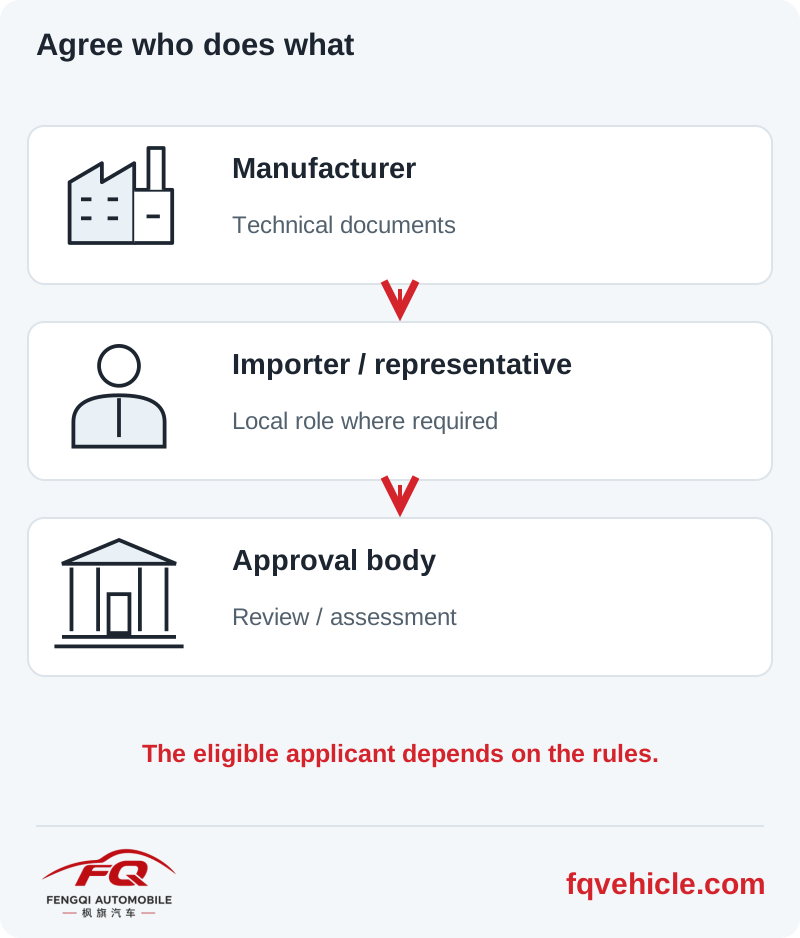
The manufacturer prepares technical information and available test evidence. The importer confirms local import and registration requirements. An authorised representative may be needed under the relevant product rules.
For example, a medical-device manufacturer outside the EU needs an EU authorised representative. This is a specific requirement, not a rule that every approval must be applied for by the buyer’s company.
Before ordering, write down who applies, who holds each approval, who pays, and who supplies the documents.
A short checklist for your order
- Country and intended work; road use or off-road use.
- Vehicle model, quantity, layout and equipment list.
- Documents already available, with holder, model, scope and validity.
- Approvals still needed, eligible applicant, cost and expected timing.
- Import, equipment-use and road-registration steps confirmed with the local responsible parties.