The Alternator Is Not Enough: Detection Vehicle Power Requirements
A 12V alternator makes about 1.8 kW; air conditioning alone needs 6-8. Why detection vehicles carry their own power, and the trade behind each route.

Ask where a detection or inspection vehicle gets its power and the answer is almost never “the vehicle”. Put the two numbers next to each other and the reason is obvious.
Air conditioning on a van this size — front and rear evaporators together — is a 6 to 8 kW class load. Cooling capacity, compressor load and electrical draw are three different numbers, and which one you quote depends on the system. All three of them sit well clear of what is left over.
The alternator on a 12 V system at 150 to 180 A is nominally 1.8 to 2.2 kW, and that is gross output, before the vehicle takes its own share.
The gap between those two numbers is the whole problem.

Why the alternator cannot carry the body
That 1.8 kW is not spare capacity. It is already running the blowers, the solenoids and the ECU, and the engine is already carrying the air-conditioning compressor on top of it.
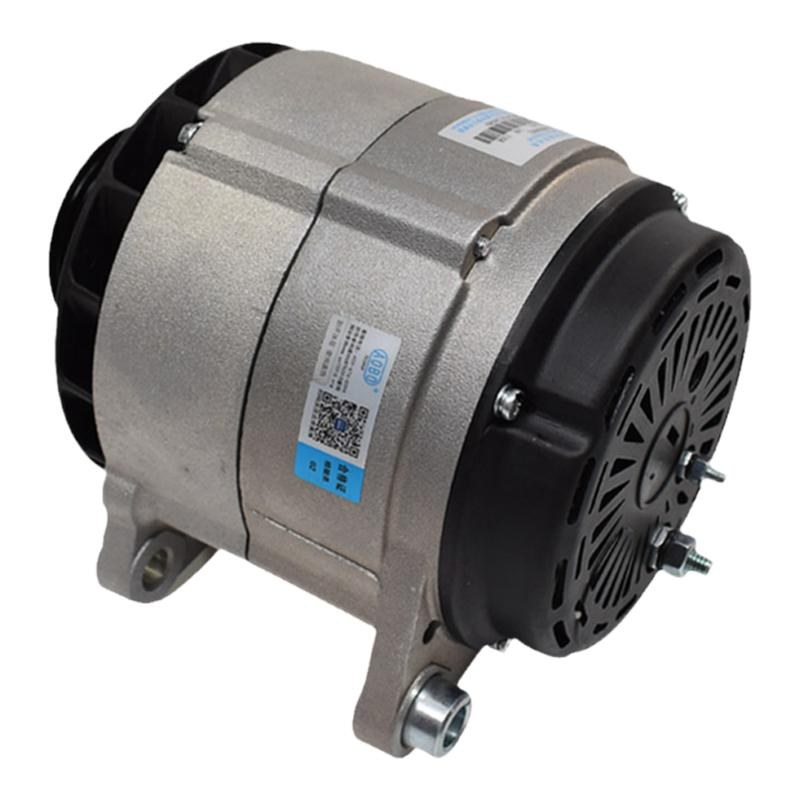
Ask for more while the vehicle is moving and you take it out of the driveline. Power for the body comes straight off engine output, and on a vehicle that is already working, that shows up as a vehicle that will not pull.
Park it and the problem does not go away. The engine no longer has to move the truck, but the alternator still makes what it makes. Around 1.8 kW against a load measured in kilowatts is not a shortfall you can engineer around.
So these vehicles get their own power. Practically all of them. Every mobile build runs a power budget; here the two numbers are simply too far apart for the vehicle’s own system to close it.
Three routes, and you pick one
In practice these are alternatives, not building blocks. Stacking them rarely pays for itself once you count cost and the space it takes.
Inverter plus lead-acid batteries. Safe, cheap, and silent. The limit is capacity: lead-acid banks in this kind of build land around 1 to 2 kWh, with a finite number of charge cycles and a ceiling on how much power you can draw at once. For the same volume it is also the heaviest option.
A generator. Run time is limited by fuel, not by state of charge, the power range is wide, and there is a lot of choice at a lot of price points. What you take on is noise, vibration, heat, and a much longer list of constraints on where it can actually be mounted.
Lithium. More capacity in the same volume than lead-acid, and silent. Two things come with it: the thermal risk that has to be designed around rather than ignored, and price — at this storage level, in the 5 to 10 kWh range, it is the most expensive of the three.
One comparison is worth stating because buyers run into it. Once the requirement reaches 5 to 10 kWh, lead-acid is out of the picture — that is not its range. At that level a lithium bank is appreciably heavier than a generator would be. That comparison is not really fair — one stores energy and the other produces it — but it is the one that surfaces as soon as somebody puts a kWh number on the table.
The load nobody estimates correctly
The instruments are the part customers can list — though not always completely, or finally. The load they underestimate is everything around them.
Air conditioning. Lighting. And heat — every piece of equipment in a sealed compartment in summer is adding to a heat load that then has to be removed, and removing it costs electricity. The environment eats more than the instrument list suggests, and it does it for the whole shift rather than in bursts.
Charging is the other half of it. Replacing what has been used from the vehicle’s own alternator is slow to the point of being unusable — the bank drains through a large pipe and refills through a tap. Once you can see it in those terms, the compromise is unavoidable: either you carry enough storage, or you carry something that generates.
There is no version where the numbers agree with the first estimate.
Where the compromise gets made
Getting to an answer takes four things from the customer: what runs and for how long, whether it runs parked or moving, how long a shift lasts, and where the vehicle operates.
Then comes the compromise. Every route is one, and it is not only an engineering one.
Silence costs capacity. Capacity costs money and mass. Run time costs noise, heat, and somewhere to put it. There is no version where you get all of it.
The budget is part of that, not an afterthought to engineer around later. Most decisions here are not “which is the best answer” — they are which compromise this programme can actually pay for. We would rather have that argument before the chassis is ordered, while it is still a choice, than after it, when it is a retrofit.
Two numbers decide it, and both come out of the body: how much continuous power it needs, and for how long. We do not need to manufacture every component in the system. Our job is to make those two numbers add up against what the vehicle can carry, what the customer needs, and what the programme can afford.
Planning a build?
Tell us your operational requirements — we'll come back with an engineered proposal.
WeChat QR

WhatsApp QR